Commercial to Residential Conversions in Treasure Valley: Unlocking Opportunity in 2025’s Changing Districts
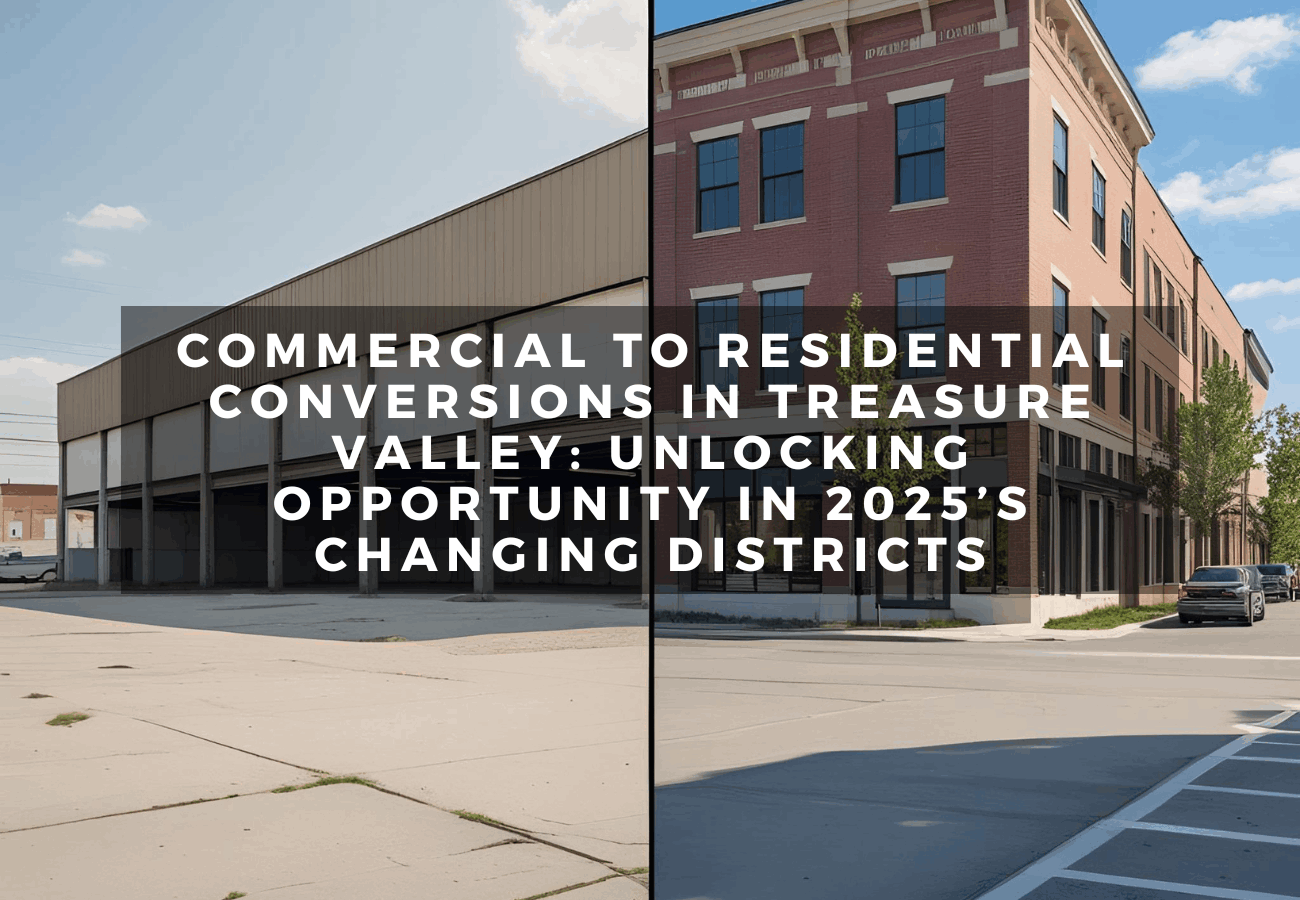
As Treasure Valley continues to evolve, one of the most compelling opportunities for investors, developers, and even municipalities is adaptive reuse, converting underutilized commercial properties into residential housing. With remote work reshaping office demand and housing inventory still lagging population growth, commercial-to-residential conversions are gaining real traction in 2025.
From former warehouses near downtown Nampa to vacant strip centers in Caldwell or old office buildings in Meridian, these properties are being reimagined as creative, cost-effective housing solutions that also revitalize neighborhoods.
This guide breaks down why adaptive reuse is accelerating across the Treasure Valley, where it’s happening, how projects are financed, and who this strategy is best suited for.
Table of Contents
- Why Adaptive Reuse Is Gaining Momentum
- Where It’s Happening in the Treasure Valley
- What Makes a Good Conversion Candidate
- Zoning, Permitting, and Red Tape
- Financing a Conversion Project
- Real-World Conversion Examples
- Who Should Consider This Strategy
- Pros and Cons of Adaptive Reuse
- Final Thoughts from Curtis
Why Adaptive Reuse Is Gaining Momentum
Housing Demand Continues to Outpace Supply
Treasure Valley’s population growth shows no signs of slowing, fueled largely by in-migration from California, Washington, and Oregon. Entry-level and mid-tier housing inventory remains tight, pushing developers to look beyond traditional subdivisions for solutions.
Vacant or Underperforming Commercial Assets
Post-pandemic shifts left many office buildings, retail centers, and light industrial spaces partially vacant or fully underutilized. These “zombie” assets often sit on valuable land with existing utilities, making them prime candidates for residential conversion.
Municipal Support for Smart Growth
Cities like Boise, Nampa, Meridian, and Caldwell are revising zoning codes, expanding urban renewal districts, and encouraging infill development. Adaptive reuse aligns well with sustainability goals and reduces sprawl.
Cost and Timeline Advantages
In many cases, converting an existing structure can be less expensive per square foot than ground-up construction. Existing foundations, utilities, and access points can shorten project timelines and reduce risk when properly vetted.
Where It’s Happening: Key Treasure Valley Corridors
Downtown Nampa
Downtown Nampa is experiencing a quiet transformation. Former retail buildings and warehouses are being converted into loft-style apartments and live/work spaces. Proximity to the train depot, library, restaurants, and public investment makes this area especially attractive for redevelopment.
Meridian Old Town and Fairview Corridor
Smaller office buildings and outdated commercial structures near Fairview Avenue are being reimagined as townhome clusters or small multi-family projects. Flexible zoning and Meridian’s continued growth make these infill opportunities increasingly valuable.
Boise Bench and West Downtown
The Boise Bench is rich with mid-century commercial buildings featuring flat roofs and open interiors, ideal for conversion. West downtown warehouse-style offices are also being rezoned for residential or mixed-use projects due to demand from healthcare, education, and tech workers.
Caldwell Redevelopment Zones
Caldwell’s downtown revitalization is spreading outward. Vacant storefronts and office buildings are being targeted for residential reuse, supported by economic development incentives and strong rental demand tied to the College of Idaho and regional job growth.
What Makes a Commercial Building a Good Conversion Candidate?
Key Property Characteristics
- Open floor plans or clear-span interiors
- Existing plumbing and electrical infrastructure
- Adequate parking or ability to reconfigure space
- High ceilings and natural light
- Solid foundations and structural integrity
- Zoning flexibility or overlay district location
Curtis Tip: Buildings constructed after 1970 with minimal environmental risk are typically more conversion-friendly and easier to finance.
Zoning, Permitting, and Red Tape
Every municipality handles conversions differently, but Treasure Valley cities are becoming more open to adaptive reuse as housing pressure increases.
Key Items to Review
- Zoning classification (mixed-use, R-3/R-4, urban renewal zones)
- Change-of-use permits
- Residential building code compliance (egress, insulation, fire safety)
- ADA and accessibility requirements
- Utility capacity and required upgrades
Working with an architect or planner experienced in adaptive reuse can save months of delays and costly redesigns.
Financing a Conversion Project
Common Financing Options
- Construction or renovation loans through local banks
- Private lenders for higher-risk or non-conforming projects
- Bridge loans during rezoning or entitlement phases
- Municipal grants or tax abatements in urban renewal areas
Curtis Insight: Lenders who understand adaptive reuse are critical. The right financing structure can make or break the feasibility of a conversion project.
Conversion Examples: What It Looks Like in Practice
Meridian Office → Four-Unit Townhome
A 2,200 sq ft single-story office was converted into four one-bedroom units with private entrances, upgraded utilities, and small patios. Post-renovation rents reached $5,200 per month with an estimated 7.5% cap rate.
Nampa Warehouse → Loft Apartments + Café
A 5,000 sq ft concrete structure became six loft-style rentals above a ground-floor coffee shop. Mixed-use zoning and downtown proximity attracted remote workers and traveling nurses.
Caldwell Bank → Luxury Single-Family Home
A former bank was transformed into a high-end residence, with the original vault converted into a wine cellar. The project gained media attention and later performed well as a short-term rental.
Who Should Consider This Strategy?
- Experienced investors seeking value-add opportunities
- Contractors or builders wanting project control
- First-time investors interested in house hacking
- Creative buyers looking for unique living spaces
Pros and Cons of Commercial-to-Residential Conversion
Pros
- Lower acquisition costs than vacant land
- Faster timelines than ground-up development
- Strong rental demand in walkable areas
- Unique properties with upside potential
- Possible tax incentives or grants
Cons
- Zoning and permitting complexity
- Higher upfront due diligence
- Potential unknown construction risks
- Specialized contractor requirements
- Not always bank-financeable without experience
Final Thoughts from Curtis
Treasure Valley’s growth isn’t slowing, but the way we add housing is changing. Adaptive reuse is becoming one of the most powerful tools for creating housing while revitalizing neighborhoods.
If you’re exploring a commercial property with conversion potential, or want a second opinion on feasibility, I’m happy to walk the property, connect you with trusted builders, and help evaluate the numbers.
Ready to explore your next conversion opportunity in the Treasure Valley?
Call or text Curtis Chism at (208) 510-0427
Email: info@chismteam.com

Curtis Chism
Explore articles on Boise's best neighborhoods, tips for buying and selling in today’s market, new construction trends, and everything you need to know about living in Idaho.
Let us be your trusted resource as you navigate the exciting world of Boise real estate!
WATCH OUR LIVING IN BOISE IDAHO VIDEOS
Check out our YouTube videos for neighborhood tours, model home walkthroughs, and honest tips about relocating to Idaho.