How Long It Takes to Adjust to Life in the Treasure Valley
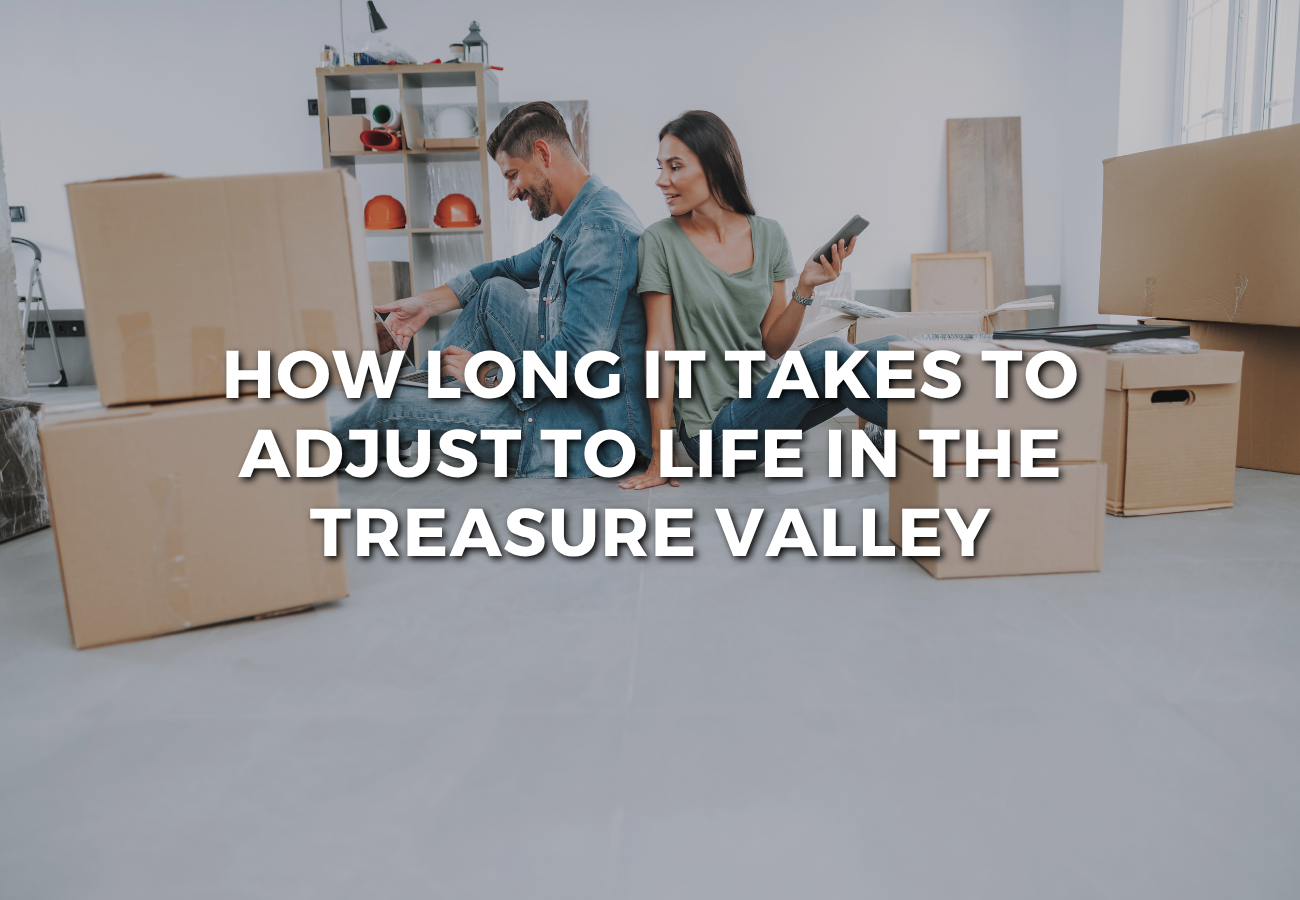
How Long It Takes to Adjust to Life in the Treasure Valley
If you are thinking about moving to the Treasure Valley, one of the biggest questions people quietly have is not just where to live or what home prices look like. It is this: how long does it actually take to feel settled here?
That is a very real question, because moving is not just a real estate decision. It is a life decision. You are not just changing addresses. You are changing routines, rhythms, friendships, weather, driving patterns, community, and your whole sense of what “normal” feels like.
And if you are relocating from out of state, especially from a place with a very different pace and culture, the adjustment is usually bigger than people expect.
The good news is this. Most people who move to the Treasure Valley do adjust well. In fact, a lot of people end up loving it here. But that does not mean it feels instant. It usually happens in stages.
Some parts of the adjustment happen quickly. You may immediately love the slower pace, the cleaner feel, the access to the outdoors, or the family-friendly environment. Other parts take more time. Building friendships, finding your favorite routines, learning the different cities, adjusting to the weather, and really feeling like this is home can take a while.
So in this guide, I am going to walk through what that adjustment process often looks like for people moving to the Treasure Valley, how long different parts tend to take, what tends to feel easy, what tends to feel harder, and how to make the transition smoother.
Quick takeaway: Most people start feeling physically settled within the first 30 to 90 days, but emotionally and socially, it often takes 6 to 18 months to fully adjust to life in the Treasure Valley and feel like it is truly home.
Table of Contents
- The Short Answer
- Why Adjusting Here Feels Different Than People Expect
- What the First 30 Days Usually Feel Like
- What Months 2 Through 3 Feel Like
- What Months 4 Through 6 Feel Like
- What 6 to 12 Months Feels Like
- Why a Full Year Matters
- How Weather Affects the Adjustment Timeline
- How Long It Takes to Build Community and Friendships
- Adjusting to the Pace of Life
- How the Adjustment Feels for Families With Kids
- Why the City You Choose Changes the Experience
- The Hardest Parts of the Adjustment for Most People
- What Helps People Adjust Faster
- FAQ
- Key Takeaways
The Short Answer
If you want the practical answer, here it is.
Most people begin to feel functionally adjusted within about 2 to 3 months. That means they know where the grocery stores are, they have found a few go-to restaurants, they have learned the basic layout of the area, and daily life no longer feels disorienting.
But that is not the same thing as feeling rooted.
For most people, truly feeling at home in the Treasure Valley takes more like 6 to 12 months. And for some, especially if they are leaving a place where they had deep friendships, extended family nearby, or a very strong sense of identity tied to where they came from, it may take 12 to 18 months.
That is not a sign that you made the wrong move. It is just how transitions work. A big move can be exciting and still take time to emotionally settle into.
Why Adjusting Here Feels Different Than People Expect
A lot of people moving to the Treasure Valley do a ton of research before they come. They watch videos. They look at neighborhoods online. They study commute times. They compare home prices. They look at schools, parks, and weather averages.
That research is helpful. It really is.
But here is what it does not do. It does not emotionally prepare you for what it feels like to actually live here every day.
That is the part people usually underestimate.
You can understand on paper that the lifestyle is slower here. But living that slower pace feels different than reading about it. You can understand that the winters are colder than where you came from, but that first stretch of gray, cold weather feels different when you are in it. You can know that the people are friendly, but building actual friendships still takes effort and time.
The adjustment is not hard because the Treasure Valley is a bad place to live. Quite the opposite. It is often hard because it is different enough from where many people are coming from that it takes time for your brain, your routines, and your expectations to catch up.
What the First 30 Days Usually Feel Like
The first 30 days are usually a mix of excitement, adrenaline, and low-level chaos.
Even when the move goes smoothly, the first month is not really about “settling in” emotionally. It is usually about getting through logistics.
You are unpacking. You are changing addresses. You are figuring out where everything is. You are learning which roads make sense. You are finding new routines for coffee, groceries, gas, school drop-off, church, gyms, kid activities, or whatever matters in your life.
This is also the period where many people are still in what I would call comparison mode. They are constantly comparing everything to where they came from.
The grocery store is different. The restaurants are different. The road layout feels different. The neighborhoods feel different. The weather feels different. Even simple things like parking lots, the pace of traffic, the amount of space around homes, and the general feel of the area may stand out a lot.
In this first month, most people are not asking, “Do I belong here?” in a deep way yet. They are mostly asking, “How do I do life here?”
That is why the first month is rarely the right time to judge whether you have adjusted. You are still just getting your footing.
What is normal in the first month: feeling excited, feeling tired, missing familiar places, second-guessing small decisions, and still feeling like you are in transition rather than truly settled.
What Months 2 Through 3 Feel Like
This is usually when life starts becoming more functional.
By this point, you have probably unpacked most of the essentials. You know where to get groceries. You have found a few places you like. You have started to understand which routes actually make sense and which ones looked better on the map than they do in real life.
This is often when the Treasure Valley starts to feel easier.
You are no longer operating in pure logistics mode. The basic friction of everyday life begins to drop. You can picture your days more clearly. You have probably figured out which parts of your new area feel convenient and which trade-offs you did not fully appreciate before moving.
For example, some people realize they love being closer to the river, foothills, or walking paths. Others realize they wish they had been closer to certain amenities. Some realize they do not mind driving a little farther if they like the neighborhood more. Others realize that commute or traffic patterns matter more than they thought.
This is also when some emotional letdown can happen. The big excitement of the move is not as strong anymore, but the deeper feeling of “home” may not be there yet either. That middle stage can feel strange.
If you are in this phase, it helps to know that it is normal. This is the stage where the novelty wears off and the real adjustment begins.
What Months 4 Through 6 Feel Like
This is usually where the move starts becoming more real in a deeper way.
By 4 to 6 months in, most people know whether the lifestyle direction feels right. They may still miss things from where they came from, but they are usually able to say whether life here feels healthier, calmer, more family-friendly, more spacious, or more aligned with what they wanted.
This is also when the strengths and weaknesses of the area you chose become clearer.
If you moved to Meridian, you may be appreciating how central it is and how much convenience it offers. If you moved to Eagle, you may be loving the river access, restaurants, and higher-end feel. If you moved to Star, you may be enjoying the small-town, patriotic feel and the quieter pace. If you moved to Nampa or Caldwell, you may be appreciating the value and space, while also learning what that means in terms of distance from other parts of the valley.
This period is also when many people start to miss their old community more sharply if they have not yet built new relationships. The move makes sense. The location may be right. But if you have not found your people yet, the emotional side can still feel incomplete.
That is why I often say that a house can feel right before life feels fully right. Those are not always on the same timeline.
What 6 to 12 Months Feels Like
This is the stage where many people really begin feeling established.
You have lived enough life here to move beyond the initial transition. You have gone through more than one season. You have had time to host people, visit local events, try different routines, and figure out what parts of Treasure Valley life actually fit you best.
For a lot of people, the 6-to-12-month mark is when they stop saying, “Where we moved from, we used to…” and start saying, “Here is what we do now.”
That shift matters.
It means your identity is beginning to catch up with your location. You are no longer just someone who moved here. You are beginning to be someone who lives here.
This is often when you start finding your favorite parks, events, restaurants, routes, and rhythms. It is when a Saturday starts feeling normal instead of improvised. It is when you know what a busy week looks like here. It is when you begin to understand how the area moves across the year.
If you have been intentional about community, this may also be when you finally start feeling relationally anchored. Not fully. But enough that the place begins to feel more familiar than foreign.
Why a Full Year Matters
I really believe one full year is important if you want to know what life in the Treasure Valley truly feels like.
Why? Because until you have gone through all four seasons, all the school-year rhythms if you have kids, all the local holidays, different traffic patterns, different weather stretches, different outdoor opportunities, and the full cycle of everyday life, you have not really experienced the whole place yet.
A lot of people visit in the best weather and assume that is the full picture. It is not.
Summer feels different than winter. Fall has a different beauty and rhythm. Spring has its own energy. Winter can feel longer than people expect if they are coming from somewhere warmer. On the flip side, summer and fall can be so enjoyable that people realize the trade-off was worth it.
After one year, most people can say with a lot more confidence, “Yes, this fits us,” or “We like it here, but we would have chosen a different part of the valley,” or “We still need more time to build community.”
That kind of clarity usually comes after experience, not just after information.
How Weather Affects the Adjustment Timeline
Weather plays a bigger role in the adjustment process than many people expect.
If you are moving from California, Arizona, Florida, or another place with very different seasonal patterns, the weather change can affect your mood, routines, and energy level more than you planned for.
The Treasure Valley gets four seasons. That is a positive for many people. But it also means there is adaptation involved.
Winter is often the biggest adjustment. Not because it is impossible, but because it is sustained. It is one thing to visit cold weather. It is another thing to live through weeks of it, with shorter days and more time indoors than you may be used to.
That does not mean winter is miserable. Many people end up liking it more than they thought they would. But it is still a change.
Summer can also surprise people, especially if they assumed Idaho would stay mild all the time. The heat can be real. The difference is that it is a dry heat, there is access to water, there are splash pads, the river, and mountain escapes, and the summer does not usually feel endless in the way it can in some hotter climates.
What matters most is expectation. When people are mentally ready for a real seasonal shift, they tend to adjust better. When they expect a near-perfect year-round climate, they often struggle more.
How Long It Takes to Build Community and Friendships
This is usually the slowest part of the adjustment process.
Finding a house is faster than finding your people. Learning the roads is faster than building friendships. Getting physically moved in is faster than creating belonging.
That is true almost anywhere, but it is especially important to understand if you are moving to the Treasure Valley expecting community to just happen automatically.
People here are generally very friendly. That helps. But friendly is not the same as instant friendship.
Most adults make friends through repeated contact. Church, school communities, sports, neighborhoods, work, clubs, kid activities, homeschool groups, gyms, and consistent social habits are what usually create connection. It rarely happens by accident.
For many people, community starts feeling real somewhere between 6 and 18 months, depending on how intentional they are and how much relational transition they are carrying from where they came from.
If you left behind deep friendships, it is normal to feel that loss for a while even if the move was the right one. A lot of people quietly interpret that loneliness as “maybe this place is wrong.” Often, it is not that the place is wrong. It is that friendship simply takes longer than unpacking boxes.
Very normal: loving the area but still feeling lonely for a season. That does not mean you made a bad move. It usually means you are still in the relationship-building stage of adjustment.
Adjusting to the Pace of Life
One of the most common things people notice after moving here is that the pace of life feels slower.
For most people, that is one of the biggest positives. They feel relief. They feel less rushed. They feel like life has more breathing room.
But even a positive change can take getting used to.
If you are coming from a larger metro, a dense suburb, or a place where everything feels fast and crowded, the Treasure Valley can feel almost disorientingly calm at first. There may be fewer nightlife options than you are used to. The restaurant scene may feel more limited than a major city. The social culture may feel more spread out and family-oriented. People may not be in the same kind of rush you are used to.
For some, that feels wonderful immediately. For others, it takes time to appreciate.
There is also an interesting thing that happens with traffic perception here. People who came from major traffic markets often say local traffic is nothing compared to where they came from. Then after living here for a while and adjusting to the slower pace, they suddenly start getting annoyed by the same traffic patterns they once thought were easy.
That is not hypocrisy. It is adaptation. Your expectations shift as you settle in.
How the Adjustment Feels for Families With Kids
Families often adjust differently than individuals or couples.
On one hand, kids can make the transition harder because there are more moving parts. Schools, routines, activities, emotional changes, and friendships all have to be rebuilt. On the other hand, kids can help the family settle faster because they create structure and repeated contact points.
Parents often start feeling more at home once the kids have activities, school friends, church routines, sports, or neighborhood connections. Once the family has a rhythm, the whole move feels less abstract and more rooted.
The biggest factor is age and stage. Younger kids often adapt faster socially, though they may still miss familiar people and places. Older kids and teens may feel the transition more deeply because friendships and identity are more established.
For parents, the emotional adjustment can also be layered. You may personally feel good about the move while still hurting because your child misses their old friends. Or you may love the new lifestyle but still feel the weight of rebuilding support systems.
That is why the family adjustment process is rarely neat. But many families do find that once new routines lock in, the Treasure Valley becomes a very easy place to raise kids.
Why the City You Choose Changes the Experience
Not every part of the Treasure Valley adjusts the same way.
The city you choose has a lot to do with how quickly you feel comfortable and how well the move fits your lifestyle.
If you choose Boise, the adjustment may feel easier if you want closer access to downtown, the Greenbelt, the foothills, more established neighborhoods, or a slightly more urban feel. If you choose Meridian, you may settle in quickly because of how central and convenient it is for so many daily needs. If you choose Eagle, the adjustment may feel smoother if you value a higher-end environment, river access, and a more curated lifestyle feel.
If you choose Star or Middleton, the pace may feel more small-town and more spread out, which some people absolutely love and others need time to adjust to. If you choose Kuna, Nampa, Caldwell, or Emmett, affordability, space, land, or certain trade-offs may be part of the appeal, but those same features may also shift the day-to-day experience in ways you have to grow into.
This is why choosing the right area is not just about home price. It is about how you want everyday life to feel once the novelty wears off.
A lot of adjustment issues are really location-fit issues. The person may like the Treasure Valley overall, but they realize the specific city or neighborhood they chose does not line up as well with how they actually live.
The Hardest Parts of the Adjustment for Most People
While every move is different, there are a few parts of the adjustment that tend to be the hardest for people relocating here.
Missing established relationships
This is probably the biggest one. You can love your new house and still miss your old people.
Learning that the move does not solve everything instantly
Some people quietly expect the new place to feel right immediately because they made such a big decision to get there. But no location fixes all discomfort right away. Every move has a settling period.
Adjusting to winter
Even people who end up liking all four seasons often need time to adapt to the winter rhythm.
Figuring out the valley geographically
On a map, the Treasure Valley can look straightforward. In real life, certain routes, traffic patterns, and city-to-city trade-offs feel different than people expected.
Understanding what lifestyle they actually use
Some people think they want one kind of location, then realize after living here that another area would have fit them better.
The in-between emotional season
This is the strange period where the old place is no longer home, but the new place does not fully feel like home yet either. A lot of people hit this phase somewhere in the first few months.
What Helps People Adjust Faster
There is no way to skip the adjustment entirely, but there are definitely things that help people settle in faster and more smoothly.
Choosing the right city from the beginning
This is one of the biggest ones. If your daily lifestyle matches the area you chose, the adjustment tends to go a lot better.
Coming out for a real discovery trip
Not just seeing houses, but actually experiencing the rhythm of different areas, makes a big difference. People who only look at homes often miss the lifestyle side. People who experience both usually make more grounded decisions.
Building routines quickly
The faster you find your grocery store, coffee place, parks, gym, church, school path, or weekend habits, the faster life starts feeling normal.
Getting outside and using the area
The Treasure Valley makes more sense when you actually use what makes it special. The parks, river, foothills, family events, and surrounding outdoor options help many people feel connected faster.
Being intentional about relationships
This is a big one. If you wait passively for community, the adjustment often feels longer. If you actively pursue it, things usually get better faster.
Giving yourself a real timeline
If you expect to feel perfectly settled in 30 days, you will probably feel discouraged. If you understand that it may take 6 to 12 months to really feel rooted, you will interpret the experience more accurately.
FAQ
How long does it take to feel at home in the Treasure Valley?
Most people start feeling functionally settled within 2 to 3 months, but emotionally feeling at home usually takes 6 to 12 months, and sometimes longer if they are rebuilding community from scratch.
Is it normal to miss where you came from even if you like it here?
Yes, completely. You can be confident in the move and still miss your old routines, friends, and familiar places.
What is the hardest part of adjusting after moving here?
For many people, it is not the home or the area. It is the social and emotional side - building friendships, creating belonging, and adjusting to a new rhythm of life.
Does winter make the adjustment harder?
For many out-of-state buyers, yes. Winter is often the season that takes the most getting used to, especially if they are coming from a much warmer climate.
Do families adjust faster than individuals?
Sometimes yes, because kids create routines and connection points. But families also have more moving parts, so the adjustment can feel more layered.
What if I like the Treasure Valley but feel like I picked the wrong area?
That can happen. Sometimes the overall move is right, but a different city or neighborhood would have fit your day-to-day lifestyle better.
How can I make the adjustment easier before I move?
Take a true discovery trip, focus on lifestyle instead of just homes, choose the right city based on how you really live, and set realistic expectations for how long emotional adjustment takes.
Key Takeaways
- Most people adjust to daily life in the Treasure Valley within 30 to 90 days.
- Feeling truly at home usually takes more like 6 to 12 months.
- Building community and friendships is often the slowest part of the adjustment.
- Weather, especially winter, can affect the timeline more than people expect.
- The city you choose has a huge impact on how natural daily life feels after the move.
- It is normal to love the area and still miss where you came from.
- One full year gives you the clearest picture of what life here really feels like.
- People who are intentional about routine, relationships, and using the lifestyle around them usually adjust faster.
Bottom line: Adjusting to life in the Treasure Valley usually happens in layers. The move may feel exciting immediately, functional within a few months, and truly rooted over the course of a year. That is normal. In most cases, it is not about whether you chose the right region. It is about giving yourself enough time to actually live into it.
Thinking About Moving to Boise or the Treasure Valley?
If you are thinking about buying a home in Boise Idaho and the Treasure Valley, one of the biggest keys is choosing the right area for how you actually live, not just what looks good online.
The smoother the location fit, the smoother the adjustment usually is.
If you want help narrowing down the right city, neighborhood, or overall strategy for your move, reach out anytime.
Email: info@curtischism.com
Call or Text: 208-510-0427
Curtis Chism
Explore articles on Boise's best neighborhoods, tips for buying and selling in today’s market, new construction trends, and everything you need to know about living in Idaho.
Let us be your trusted resource as you navigate the exciting world of Boise real estate!
WATCH OUR LIVING IN BOISE IDAHO VIDEOS
Check out our YouTube videos for neighborhood tours, model home walkthroughs, and honest tips about relocating to Idaho.