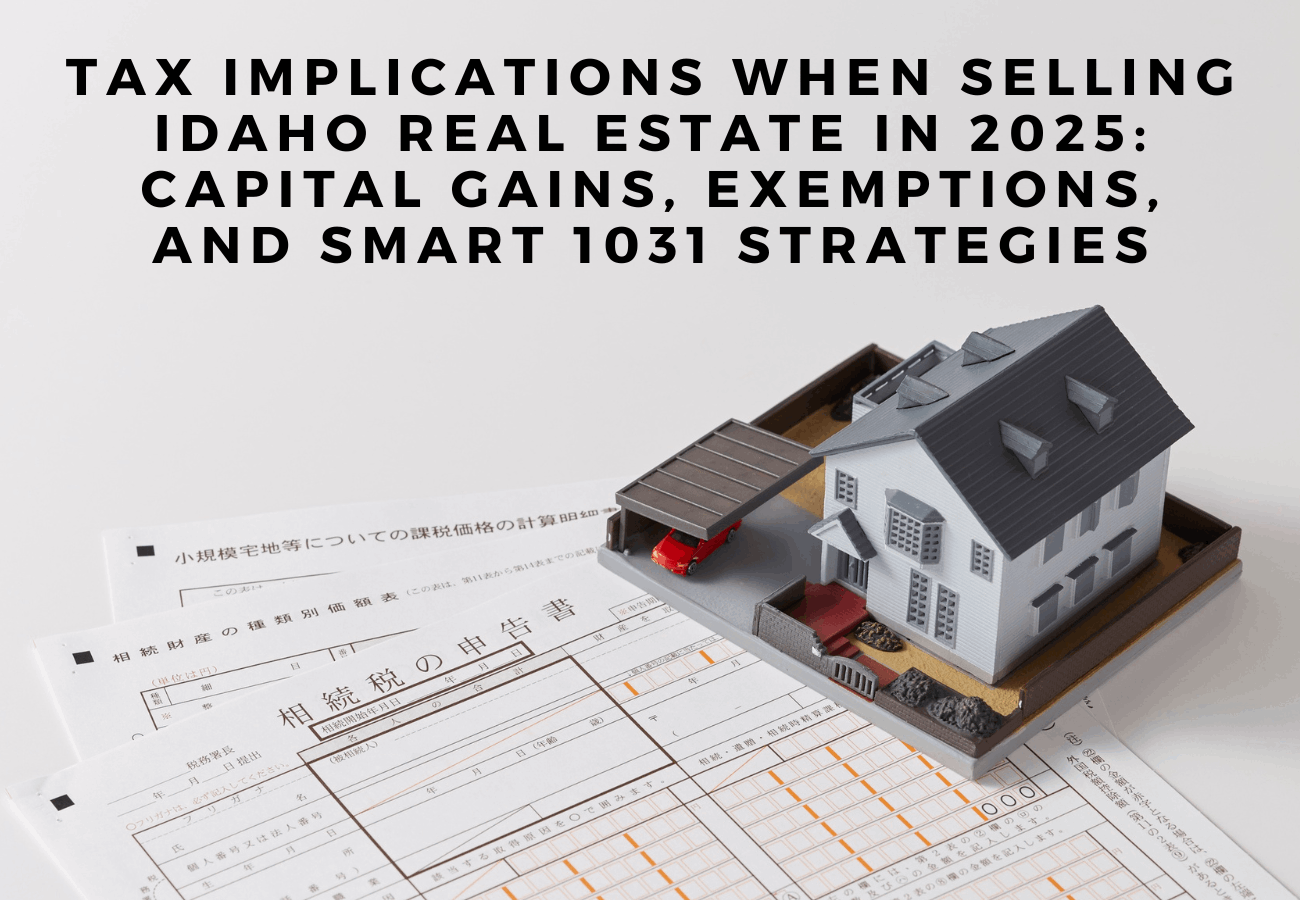
Tax Implications When Selling Idaho Real Estate in 2025: Capital Gains, Exemptions, and Smart 1031 Strategies
Selling a home or investment property in Idaho can lead to big financial gains, but it can also lead to a big surprise when tax season rolls around. Whether you’re cashing out equity, downsizing, relocating, or selling a rental, it’s important to understand how taxes can impact your net proceeds before you close.
Disclaimer: This is not tax advice. Always consult your CPA or tax professional for guidance on your specific situation.
Table of Contents
- What Is Capital Gains Tax?
- Exemptions for Primary Residences (Section 121)
- What If the Home Was a Rental or Vacation Property?
- Depreciation Recapture (The One Sellers Miss)
- Using a 1031 Exchange to Defer Capital Gains
- Idaho-Specific Tax Considerations
- Smart Strategies to Minimize Taxes
- Inherited vs. Gifted Property
- Buy-and-Hold vs. Exit in 2025
- Final Thoughts
Selling Real Estate in Idaho? Know the Tax Impacts Before You Close
When you sell real estate for more than you paid (after adjusting for certain costs), the IRS considers the difference a capital gain. In simple terms, capital gains tax is the tax on your profit.
Short-Term vs. Long-Term Capital Gains
- Short-term capital gains (held less than 1 year): taxed as ordinary income (your federal tax bracket).
- Long-term capital gains (held more than 1 year): typically taxed at 0%, 15%, or 20% federally, depending on your taxable income.
Simple Example
You bought a home in Boise for $400,000 in 2020 and sell it in 2025 for $650,000. That’s a $250,000 gain before adjustments. In reality, you can often reduce the taxable gain using selling costs and qualifying improvements.
- Potential subtractions: real estate commissions, some closing costs, and documented capital improvements.
- Result: your taxable gain may be lower than the “headline” profit number.
Exemptions for Primary Residences
If the property you’re selling has been your primary residence, you may qualify for a significant capital gains exclusion under Section 121 of the IRS code.
How Much Can You Exclude?
- Up to $250,000 of gain if you’re single
- Up to $500,000 of gain if you’re married filing jointly
Basic Requirements
- You owned and lived in the home for at least 2 out of the last 5 years
- You have not claimed this exclusion on another home sale in the past 2 years
What Helps Increase Your “Cost Basis” (and Reduce Taxable Gain)?
Keep records of capital improvements that add value or extend the life of the home, like a remodel, new roof, new HVAC, windows, or major landscaping. These can increase your cost basis and lower your taxable gain.
If you qualify for Section 121, this exclusion can wipe out capital gains tax entirely for many homeowners.
What If the Home Was a Rental or Vacation Property?
If you’ve been renting out the property and it was not your primary residence, you typically do not qualify for the full Section 121 exclusion. That means your gain may be taxable, and depreciation rules come into play.
- Rental property: gain may be taxed, and depreciation recapture can apply.
- Vacation home: tax treatment depends on how much it was rented vs. personally used.
The biggest mistake I see sellers make is assuming a rental sale is taxed “the same way” as a primary home sale. It’s not.
Depreciation Recapture
If the property was a rental, you may have taken depreciation each year on your tax return. The IRS may “recapture” that depreciation when you sell, meaning it can be taxed at a higher rate (often up to 25%) even before your capital gains rate is applied.
Example
If you’ve taken $40,000 in depreciation over time, you may owe $10,000 in depreciation recapture tax (25% of $40,000) depending on your situation, even before calculating your capital gains tax.
This is why investors often plan their exit strategy well before listing the property.
Using a 1031 Exchange to Defer Capital Gains
A 1031 exchange allows you to defer capital gains taxes when selling investment or business property, as long as you reinvest the proceeds into another like-kind property and follow the rules.
Core 1031 Rules
- It must be investment or business property (not your primary residence)
- Identify replacement property within 45 days
- Close on the replacement property within 180 days
- Use a Qualified Intermediary (QI)- you cannot touch the funds
What “Like-Kind” Usually Means
In real estate, “like-kind” is broader than most people think. In many cases you can exchange:
- A rental house for a multi-unit property
- Land for a rental property
- Commercial for residential rental (and vice versa)
You generally cannot exchange U.S. property for international property, and you cannot use a 1031 to buy a personal home.
Idaho-Specific Tax Considerations
Capital gains are a federal issue, but Idaho may also tax certain gains as part of your state income. If your gain is not excluded under federal rules and not deferred via a 1031 exchange, state income tax may apply.
Property Tax Notes at Closing
- Property taxes are typically prorated at closing
- Sometimes buyers negotiate seller credits that effectively cover a portion of taxes
- Property taxes do not create capital gains tax, but they may be deductible in the year of sale (ask your CPA)
Smart Strategies to Minimize Taxes
1) Keep Great Records
Track your original purchase price, closing costs, capital improvements, and depreciation. Good documentation can materially reduce your taxable gain.
2) Time the Sale Intentionally
If you’re close to the 2-year primary residence rule, or you expect your income to drop next year, timing can change your tax outcome. A small shift in timing can mean a lower bracket, a larger exclusion, or less tax overall.
3) Convert a Rental to a Primary Residence (When It Makes Sense)
In some situations, if you live in the home for 2 out of the last 5 years, you may qualify for the Section 121 exclusion even if it was previously a rental. There are important limitations and formulas that may apply, so this is a CPA conversation - but it can be a powerful planning tool.
4) Partial Exclusion in Special Situations
If you sell due to certain life events (job change, health reasons, hardship), you may qualify for a partial exclusion. This is often prorated based on how long you lived in the home.
What About Inherited or Gifted Property?
Inherited Property
In many cases, inherited property receives a “stepped-up” cost basis to the fair market value at the time of the previous owner’s death. That means many heirs owe little or no capital gains tax if they sell shortly after inheriting, because the gain is measured from that newer value.
Gifted Property
Gifted property generally carries over the original cost basis from the giver. This can create a larger taxable gain if the property has appreciated significantly over time.
Selling Investment Property in 2025: Buy-and-Hold vs. Exit
If you’re holding multiple properties in Treasure Valley and considering selling in 2025, here are a few planning angles investors commonly explore with their CPA and lender:
- 1031 exchange: roll gains into a higher-performing asset while deferring taxes
- Seller financing: spread gains across years and potentially smooth tax impact
- Cash-out refi: access equity without triggering a taxable sale (not always ideal, but an option)
The best move depends on your income, timeline, reinvestment plans, and risk tolerance. This is where aligning your real estate plan with your tax plan really matters.
Final Thoughts
Selling real estate is not just about the sale price - it’s about your net proceeds after commissions, closing costs, and taxes. A little planning can mean keeping significantly more of your profit.
While I’m not a CPA, I’ve helped many clients sell, exchange, and reposition properties strategically, and I’m happy to coordinate with your CPA, financial planner, and lender so the real estate side supports the tax strategy you’re aiming for.
Want help planning your next real estate move?
Call or text Curtis Chism at (208) 510-0427
Email: info@chismteam.com
Ready to relocate remotely? Download our Boise Relocation Guide

Curtis Chism
Explore articles on Boise's best neighborhoods, tips for buying and selling in today’s market, new construction trends, and everything you need to know about living in Idaho.
Let us be your trusted resource as you navigate the exciting world of Boise real estate!
WATCH OUR LIVING IN BOISE IDAHO VIDEOS
Check out our YouTube videos for neighborhood tours, model home walkthroughs, and honest tips about relocating to Idaho.