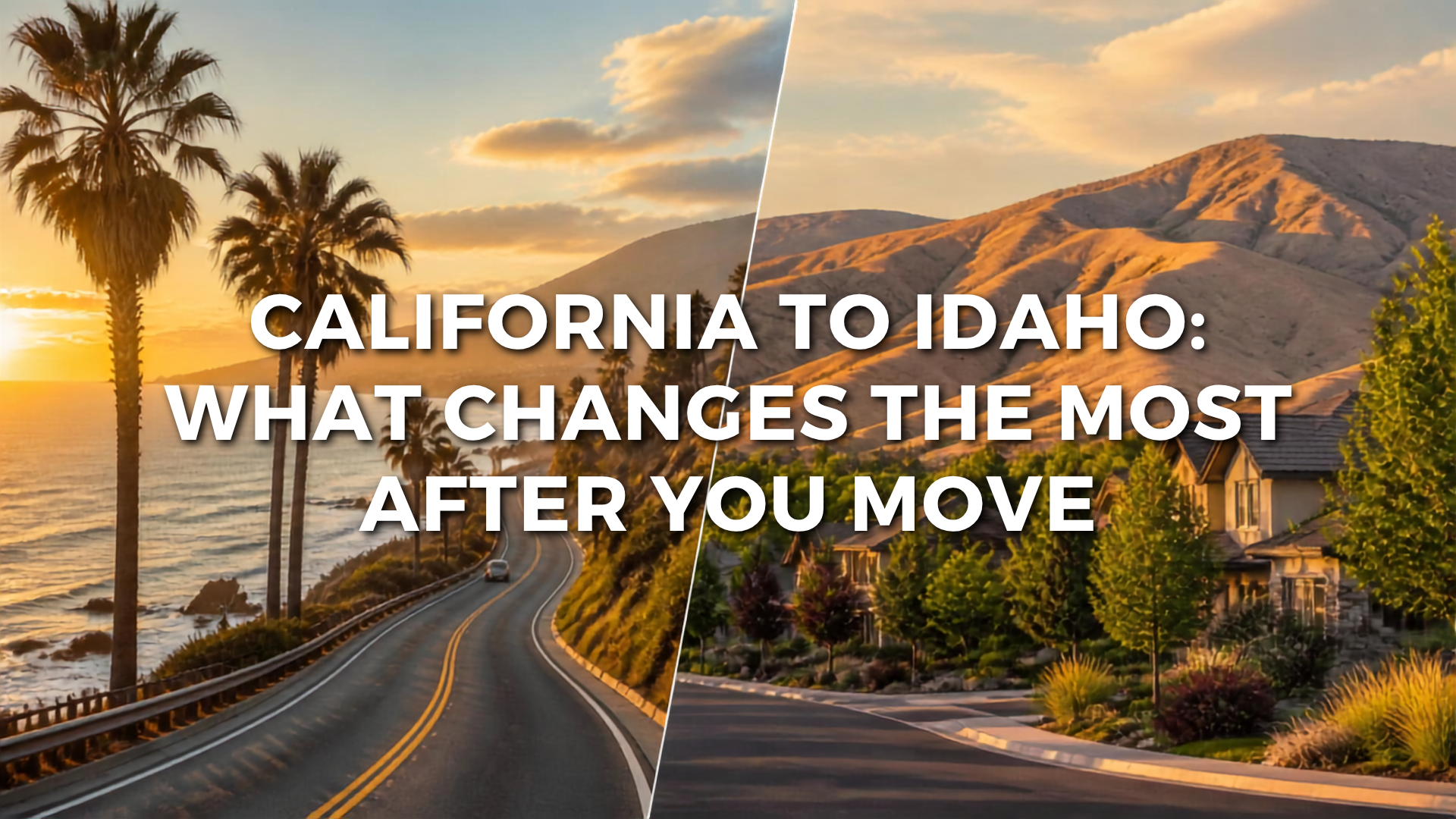
I've been asked some version of this question hundreds of times: what actually changes when you move from California to Idaho? Not what's different on paper — the tax rates, the home prices, the square footage — but what changes in the lived experience. The daily stuff. The things you notice in the first week, the things that take a year to fully absorb, and the things you didn't expect to matter that turn out to matter most.
I relocated from San Diego four years ago. Third-generation San Diegan. My kids are fourth generation. I left a place I genuinely loved for a place I've come to love differently, and I've spent the years since helping families from California, Oregon, and Washington navigate the same transition. This post is what I actually tell people when they ask that question — the real answer, not the pitch.
- Your Financial Life Changes Immediately and Visibly
- The Pace of Daily Life Changes — and It Takes Time to Trust
- Your Relationship With the Outdoors Changes Completely
- Seasons Become Real and Require Active Participation
- Community Starts From Zero — and Grows Differently
- The Regulatory Friction in Your Life Disappears
- Food Changes — and Not Just at Restaurants
- Your Identity Shifts in Ways You Don't Expect
- The Distance From Family Is Its Own Adjustment
- The Nostalgia Is Real and Doesn't Fully Go Away
- Frequently Asked Questions
Your Financial Life Changes Immediately and Visibly
The financial shift is the first thing you feel, and it's concrete enough to be jarring in the best way. The first time I registered my truck in Idaho — $75 — I sat in the parking lot staring at the receipt. I'd paid over $800 in California for the same truck the previous year. That was the moment it became real. Not the home price comparison, not the income tax differential — a receipt for $75.
The pattern repeats in the first few months in small and medium ways. Your homeowners insurance is a fraction of what California carriers were quoting — or what the California carriers who hadn't already left the market were quoting. Your property tax bill, when it arrives, looks like a rounding error compared to what you were paying or projecting to pay. Your utility bills are lower. If you're on pressurized canal irrigation, you water your lawn all summer for $186 a year. The grocery tax is a genuine annoyance — Idaho taxes groceries at 6%, California doesn't — but it's the only consistent financial category where Idaho comes out worse.
What this produces over six to twelve months isn't just a better bank account — it's a different relationship with money. People who've been financially stretched in California for years, watching their income consumed by rent or a mortgage that didn't leave them breathing room, describe a genuine shift in how they feel about their financial situation. Not rich. Not without concerns. But breathing. The mental overhead of perpetual financial tightness — which is invisible when you're inside it — becomes visible when it lifts. That's one of the more consistent things I hear from clients a year in: they didn't know how tense they'd been until it stopped.
The Pace of Daily Life Changes — and It Takes Time to Trust
This is one of the most significant changes and one of the hardest to describe to someone who hasn't experienced it. California's daily life — at least in the major metros where most of my clients have come from — runs at a particular pace. Dense traffic, competitive parking, long waits, lines, appointments that are hard to get, services that require planning well in advance, and a general operational friction to every transaction. You adapt to it. It becomes normal. You build your schedule around it without realizing how much of your daily decision-making is organized around managing that friction.
In Idaho, that friction is dramatically reduced. Commutes here average 20 to 30 minutes. Parking is available. Restaurant reservations are usually possible the day you want them. You can get your kids into a youth sports league without a lottery. You can see a doctor — sometimes even the same week. Contractors call back. Lines at the DMV resolve in 45 minutes instead of half a day. The aggregate of all these small frictions being reduced is a genuine change in how much cognitive overhead your daily life consumes.
The part that takes time to trust: many California transplants spend their first six months in Idaho waiting for the friction to come back. They book things further out than they need to. They allow more time than necessary. They're braced for the experience that didn't materialize. By year two, most people have genuinely recalibrated. The new pace feels normal rather than temporarily fortunate. That recalibration — from braced to at ease — is one of the most consequential quality-of-life changes in this move, and it's almost impossible to fully anticipate before you've lived it.
Your Relationship With the Outdoors Changes Completely
If you grew up in Southern California, you probably think you have outdoor access. You probably go to the beach occasionally. You might hike. You've maybe been to Yosemite once or twice. Your relationship with the outdoors is real but it's structured around events — deliberate planned trips to specific destinations that require logistics, drive time, crowds, sometimes reservations months in advance.
In the Treasure Valley, outdoor access starts at the city's edge without any of that infrastructure. Over 180 miles of hiking, mountain biking, and trail running routes begin at the end of North End neighborhoods in Boise — no permit, no reservation, no trailhead parking scramble. The Boise River Greenbelt runs 25 miles through the valley and is accessible from dozens of entry points on a moment's notice. Eagle Island State Park requires only a $10 annual sticker added to your vehicle registration.
What changes isn't the quality of the landscape — California has extraordinary landscapes. What changes is the access friction and therefore the frequency. People who went outdoors on planned weekend trips two or three times a month in California find themselves going on a Tuesday evening in Idaho. The foothills in the morning before work. The river on a random Sunday when nothing else is planned. That shift from outdoor activities as events to outdoor activities as daily rhythm is one of the most consistently described quality-of-life improvements I hear from clients a year in. My family went to Kirkham Hot Springs — natural hot springs in the Sawtooth National Forest about two hours from Boise — within our first few months here. I'd lived in San Diego for decades and never made it to a comparable experience even though beautiful places were theoretically within range.
Seasons Become Real and Require Active Participation
California has seasons in a technical sense. Idaho has seasons in the real sense — the kind where the environment actually changes around you, where your wardrobe has to be seasonally managed, where your calendar and your activities shift genuinely with the time of year. This is something Southern California transplants consistently underestimate as an adjustment and consistently come to appreciate within a year or two.
Fall here is stunning in a way that California doesn't offer — the entire valley turns amber and gold, the air gets that particular crispness that doesn't exist in a Mediterranean climate, and the combination of the light and the temperature and the color produces something genuinely beautiful that you experience rather than just observe. Spring arrives with the kind of relief that only makes sense if you've been through a real winter. Summer is intense and full and completely different from fall, which is completely different from winter. The rhythm of the year becomes real in a way it wasn't when every month looked roughly the same.
The winter adjustment is the hard part, and I've written about this at length in other posts. The cold itself is manageable. The inversion — cold air trapped in the valley basin for days or weeks at a time, producing flat gray sky — is the part that catches California transplants without a playbook. By year two or three, you've built the winter toolkit: the trip somewhere warm in January, the awareness of when inversions typically break, the appreciation for the clear days between them. But year one is genuinely an adjustment, and it's worth going in knowing that rather than discovering it in February.
Community Starts From Zero — and Grows Differently
This is the change that takes the longest to feel and the one that ultimately produces some of the highest satisfaction. When you move from California to Idaho, you leave behind your entire social infrastructure — the friends you've had for years, the neighbors you know, the church community you've built, the professional network you've developed. All of it requires rebuilding from scratch in a new place. That's a real loss, and it deserves to be named as one rather than minimized.
What grows in its place is different in character. The community you build in Idaho feels more intentional, more genuinely chosen, than the community you accumulated over decades in California — because you built it deliberately in a place where nobody was obligated to include you. The neighbors who showed up for your moving truck, the families you met at the community pool, the people you found at church in the first year — those relationships have a different quality than the ones you fell into by proximity and history over twenty years.
I've seen this consistently across four years and hundreds of client families. The people who thrive here are the ones who show up — who engage with the community rather than waiting for it to come to them. Idaho will not chase you down. But if you walk out your door, introduce yourself, and show up for the people around you, the community that forms tends to be more genuine, more grounded, and more oriented around shared values than many California transplants describe having had in years.
The Regulatory Friction in Your Life Disappears
This one is subtle until it's suddenly obvious. California's regulatory environment has accumulated decades of rules, requirements, mandates, and restrictions that touch daily life in a hundred small ways — vehicle inspections, smog checks, specific product restrictions, building and land use regulations, professional licensing complexity, educational mandates, and a general orientation of government toward management of individual behavior. You adapt to it. It becomes background noise you stop hearing.
Idaho's orientation is different. Constitutional carry — you can carry a firearm without a permit. No vehicle inspections, no smog checks. School choice that is meaningfully real, including the $5,000 per child parental tax credit for qualifying private and homeschool programs. An income tax that just went down, not up. A homeschool framework that requires notifying your district and nothing else — no curriculum review, no testing requirements. And something harder to quantify: the general sense that the state isn't continuously looking for new ways to insert itself between you and how you choose to live your life.
The mental bandwidth you get back when you stop bracing for the next policy, the next mandate, the next fee or restriction — it shows up in how you feel about your daily life. I didn't fully anticipate this before I moved. I expected the financial improvement. I didn't expect the specific relief of operating in a state whose default posture is to leave you alone. It's real, and it compounds over time in a way that makes the California experience feel increasingly foreign in retrospect.
Food Changes — and Not Just at Restaurants
Let me be honest about both sides of this. The restaurant gap between California and Idaho is real and I wouldn't insult your intelligence by pretending otherwise. The depth and diversity of California's food culture — the authentic regional Mexican food, the world-class sushi, the international variety that comes from genuinely diverse immigrant communities — doesn't exist in Boise in the same way, and it won't for many years. If you're a serious food person whose quality of life is significantly tied to access to excellent and varied cuisine, this is the aspect of this move that will require the most honest self-assessment.
But the other side of the food story is the one I didn't expect and have genuinely come to value: the direct access to local food production that Idaho's agricultural character makes possible. I buy beef directly from a rancher friend — half a cow at a time, non-GMO grain-finished, about $10 to $12 per pound across all cuts with full selection. I watched the cattle graze on his property. I know exactly where it came from. Raw milk is delivered to my door for $8 a gallon. Farm eggs from roadside honor-system stands where you Venmo the farmer and leave with eggs laid that morning. This kind of direct relationship with food production simply wasn't available to me in a San Diego suburb, and it's changed how my family thinks about and experiences food in a way that the restaurant comparison doesn't capture.
Your Identity Shifts in Ways You Don't Expect
California has a strong identity, and if you grew up there — especially in San Diego or the Bay Area or Los Angeles — some of that identity is yours whether you claimed it consciously or not. The beach is part of who you are. The weather is part of how you think about home. The cultural mix, the pace, the specific flavor of West Coast life is baked into your experience of yourself.
Moving to Idaho involves, over time, a genuine identity shift. You start thinking of yourself as an Idahoan. The things you take for granted change — instead of the beach, it's the foothills; instead of perpetual sunshine, it's the dramatic seasons; instead of density and speed, it's space and simplicity. That shift doesn't happen in the first year. It usually starts in the second, accelerates in the third, and is largely complete by the fourth. I realized I'd made it when I drove back to San Diego to visit family and felt like a visitor — not like I was returning home.
The Distance From Family Is Its Own Adjustment
I want to be straight about this because it's the aspect of relocation content that gets glossed over most consistently. If your family is in California — parents, siblings, the people your kids grew up calling grandparents and aunts and uncles — that 800-plus mile distance is a real and ongoing cost. You feel it at Thanksgiving and Christmas, obviously. You also feel it when something small happens — a parent has a medical appointment, a sibling is going through something, your nephew had a great game — and you're not there for it in the casual way you would have been if you lived 20 minutes away.
This doesn't mean the move is wrong. For many families, the overall trade is still clearly worth it, and relationships maintained with intention can be deep and real across distance. But the people who navigate this best are the ones who planned for it explicitly — budgeted for flights, scheduled visits with the same seriousness as any other priority, and made their continued presence in extended family life a deliberate practice rather than assuming distance would just work itself out. The families who struggle most with this are the ones who underestimated the emotional weight of it before they moved. Go in with eyes open.
The Nostalgia Is Real and Doesn't Fully Go Away
Four years in, I still occasionally miss San Diego. Not enough to go back. But genuinely, specifically. The beach on a January afternoon when it's 70 degrees and the Pacific is right there. The particular quality of the food in places I knew well. The specific neighborhoods that shaped how I grew up. The deep familiarity of a place where I knew the streets and the rhythms at a level that takes decades to build anywhere else.
That nostalgia is not a sign that you made the wrong decision. It's a sign that you came from somewhere real. The people who seem most at peace with the move after a few years aren't the ones who feel nothing about what they left — they're the ones who hold both true simultaneously. They love what they built in Idaho and they remember what they valued in California, and those two things coexist without contradiction. The goal isn't to stop missing California. The goal is to love Idaho enough that the missing doesn't feel like a mistake, just like a loss that was worth what you gained.
Frequently Asked Questions
What changes the most when you move from California to Idaho?
The most significant changes fall into several categories: your financial life improves quickly and visibly through lower property taxes, homeowners insurance, vehicle registration, and overall housing costs; the pace of daily life slows in a way that reduces cognitive overhead you didn't know you were carrying; your relationship with the outdoors shifts from event-based to daily-rhythm; community has to be built from scratch but tends to grow with more intentionality than what many transplants had in California; and the regulatory friction in daily life — vehicle inspections, progressive tax structure, mandates, restrictions — largely disappears. The hardest adjustments are the winter inversion, the distance from California family, and the food and culture scene gap.
Is the quality of life better in Idaho than California?
For many California households — particularly those who were financially stretched, craving outdoor access, prioritizing family safety, or seeking a more conservative political and cultural environment — quality of life in Idaho is meaningfully better. The financial improvement is real and consistent. The outdoor access is genuinely excellent. The community feel in Idaho's suburban neighborhoods is strong. The honest tradeoffs are the food and culture gap relative to California's major metros, the winter weather adjustment, total car dependency, and family distance if your roots are in California. Quality of life is ultimately personal — what you're optimizing for determines whether Idaho wins the comparison for your household.
Do California transplants regret moving to Idaho?
Some do — and it's almost always traceable to specific expectation mismatches rather than Idaho being wrong for them inherently. The most common sources of regret: underestimating the winter inversion and arriving without a plan for it, buying in the wrong part of the valley for how they actually live, expecting the community to form automatically without putting in the work of building it, and underestimating how much they'd miss the food scene or family proximity. People who come in with accurate expectations and a genuine commitment to building a life here — rather than waiting to see if they like it — consistently land well.
How long does it take to feel at home in Idaho after moving from California?
Most people I work with describe a meaningful shift happening sometime in the second year — when the new patterns feel normal rather than temporary, when relationships have depth rather than just novelty, when the seasons are familiar rather than disorienting, and when Idaho starts feeling like home rather than where they currently are. The identity shift — genuinely thinking of yourself as an Idahoan rather than a Californian in Idaho — tends to happen in years three and four. Some people arrive and feel immediately at home. Most take 18 to 24 months to genuinely settle in.
What do California transplants miss most about California after moving to Idaho?
The four things I hear most consistently: the beach and the particular emotional relationship with the Pacific Ocean; the depth and diversity of California's food scene — authentic ethnic food, world-class sushi, the variety that comes from genuinely international communities; the mild year-round weather, particularly San Diego and Bay Area January temperatures; and proximity to family. Everything else — the traffic, the cost, the regulatory environment, the density — almost nobody misses. But those four things are real and the people who handle the move best are the ones who acknowledged them honestly before they left rather than convincing themselves they wouldn't matter.
Is moving from California to Idaho financially worth it?
For most California households with stable income and a five-plus year time horizon, yes — significantly. The overall cost of living differential runs 24 to 40% lower in Idaho depending on which categories you weight. The income tax savings (Idaho's flat 5.3% vs. California's 8 to 13.3%) represent $3,700 to $20,000+ per year depending on household income. Vehicle registration drops from $300 to $800+ to $75 per vehicle. Property taxes on comparable homes run $2,000 to $5,000 lower annually. Homeowners insurance is a fraction of California's crisis-level pricing. The total annual savings for many families runs $10,000 to $30,000 per year — money that compounds meaningfully over time and creates the financial breathing room that most California families haven't had in years.
Key Takeaways
- The financial shift is immediate and concrete — $75 vehicle registration, dramatically lower property taxes, lower homeowners insurance, and lower overall daily costs produce a measurable change in financial breathing room within months.
- The pace of daily life slows in a way that reduces cognitive overhead you didn't know you were carrying. Commutes, parking, reservations, appointments, and most daily transactions are easier — and trusting that improvement takes up to a year to fully internalize.
- Your relationship with the outdoors shifts from event-based to daily rhythm. The Boise Foothills, the Greenbelt, and surrounding recreation are so accessible that people who went outdoors twice a month in California go twice a week in Idaho.
- Community has to be built from scratch — the grief of leaving your California network is real and deserves to be named. What grows in its place tends to be more intentional and more genuinely values-aligned than what many transplants describe having had in years.
- The regulatory friction in daily life — vehicle inspections, progressive taxes, mandates, restrictions — largely disappears, producing a mental bandwidth recovery that most people didn't anticipate and consistently describe as significant.
- The food and culture gap from California is real and doesn't fully close. The direct food sourcing available in Idaho — farm-direct beef, raw milk, farm eggs — is a genuine partial offset that California suburban life doesn't offer.
- The nostalgia for California doesn't fully go away, and it doesn't need to. The people who are most at peace hold both true: they love what they built in Idaho and they remember what they valued in California without treating the nostalgia as evidence they made the wrong call.
- The identity shift from Californian to Idahoan typically takes three to four years to feel complete — and it's one of the more quietly significant aspects of this kind of move.

Curtis Chism
Licensed Idaho Real Estate Agent • eXp Realty • License #SP56593
Four years in, three homes owned, multiple businesses built, and this is still the most honest account I can give of what actually changes. I help families navigate this same transition every week. Learn more at weknowtreasurevalley.com/about.
Ready to Talk Through What This Move Actually Looks Like for You?
I've made this move myself and helped hundreds of California families navigate it. Let's have an honest conversation about your specific situation before you commit to anything.
Get the Relocation Guide Call or Text: 208-510-0427