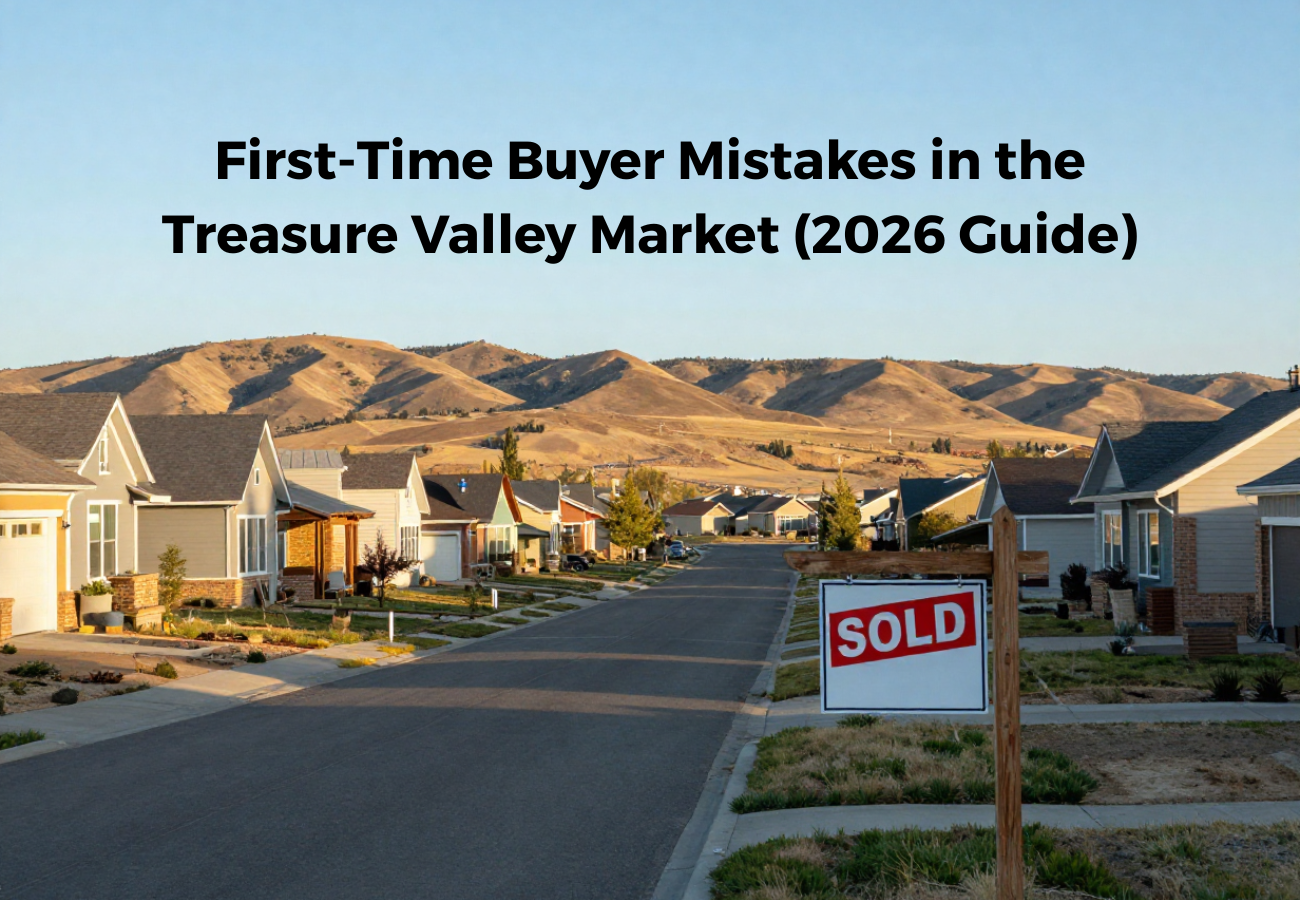
I've watched a lot of first-time buyers walk into this market excited, prepared in some ways, and completely blindsided in others. The Treasure Valley isn't a hard market to buy in — but it has its own specific landmines that don't show up in generic homebuying advice you'll find online. Most of what's written about first-time buyer mistakes is written for a national audience and misses the things that are actually specific to Boise, Meridian, Eagle, and the rest of this valley.
This post is the list I wish every first-time buyer read before they started touring homes. Not the obvious stuff — get pre-approved, don't skip the inspection — though I'll touch on those too. The stuff that's specific to this market and costs people real money when they get it wrong. I've watched these mistakes happen dozens of times, and almost all of them are avoidable with the right information up front.
If you're relocating from out of state, the relocation guide covers the broader picture. If you're already local and just navigating your first purchase, this post is built specifically for you. Either way, the city guides for Boise, Meridian, Eagle, and Nampa are worth reading alongside this one.
- Mistake #1: Confusing Pre-Qualification With Pre-Approval
- Mistake #2: Not Asking About Irrigation Before You Offer
- Mistake #3: Shopping by Purchase Price Instead of Payment
- Mistake #4: Not Knowing About Idaho's First-Time Buyer Programs
- Mistake #5: Accepting Junk Fees From Big Lenders
- Mistake #6: Assuming the Lot Will Be Bigger Than It Is
- Mistake #7: Taking the First Insurance Quote
- Mistake #8: Choosing the Wrong Agent for the Job
- Mistake #9: Underestimating Commute and Location Fit
- Mistake #10: Misreading New Construction Incentives
- Mistake #11: Skipping or Rushing the Inspection
- Frequently Asked Questions
Mistake #1: Confusing Pre-Qualification With Pre-Approval
This is the single most common mistake I see, and it costs people homes. A pre-qualification is a quick, informal estimate based on numbers you self-report to a lender — no credit pull, no document verification, no real commitment behind it. A pre-approval means a lender has actually pulled your credit, verified your income and assets through documentation, and issued a written commitment for a specific loan amount. In a market where well-priced homes still generate multiple offers, sellers and listing agents can tell the difference between these two documents immediately. A pre-qualification letter from a big national bank is, frankly, close to worthless in a competitive offer situation here.
Get a full pre-approval before you start touring homes seriously — not after you've found the one you want. The process takes a few days to a week depending on your lender and how organized your documentation is. Doing it early means you're not scrambling when the right house comes up, and it means you know your real number instead of an optimistic guess.
Mistake #2: Not Asking About Irrigation Before You Offer
This is the most Treasure Valley-specific mistake on this entire list, and almost nobody outside this market would even know to ask the question. Most neighborhoods here use pressurized irrigation — a separate non-potable canal water system specifically for lawn watering that doesn't touch your domestic water meter. Homes on this system pay around $135 to $190 per year for essentially unlimited summer watering. Some newer communities even bundle this cost into the HOA fee.
But not every property has it. Some older neighborhoods, particularly in parts of Boise, are on domestic city water for irrigation — and that changes your summer water bill dramatically. I know a homeowner on domestic irrigation in Boise paying close to $400 a month during peak summer watering season. That's $2,000 to $2,800 over an irrigation season for the exact same lawn that costs someone else $190 for the entire year. Before you make an offer on any home in the Treasure Valley, ask your agent specifically: is this property on pressurized canal irrigation or domestic water? It's one question that can be worth thousands of dollars a year, and most first-time buyers have never even heard of it.
Mistake #3: Shopping by Purchase Price Instead of Payment
When you're scrolling Zillow, it's easy to fixate on the listed price. But your purchase price doesn't pay your bills every month — your monthly payment does. Because property tax rates and insurance costs vary by location, a $450,000 home in Nampa or Caldwell can have a noticeably different monthly payment than a $450,000 home in Boise, Meridian, or Eagle. Interest rates, loan type, and the specific tax district a property sits in all factor into the real number.
Before you fall in love with a specific listing, have your lender or agent run an actual payment scenario for that exact address — not a generic calculator estimate. This matters even more in communities with a Community Improvement District (CID) tax, like Harris Ranch in Boise or Valnova in Eagle, which adds roughly half a percent permanently to your property tax bill. That's the kind of detail that doesn't show up in the listing price but absolutely shows up in your payment every month for as long as you own the home.
Mistake #4: Not Knowing About Idaho's First-Time Buyer Programs
Idaho doesn't run a single flashy government-funded down payment program the way some states do, but there are real resources available that many first-time buyers never discover because nobody told them to look. The Idaho Housing and Finance Association (IHFA) offers tax credits, competitive bond loan programs, and down payment assistance for buyers purchasing a single-family home, condo, townhome, or manufactured home. Many buyers assume they make too much money to qualify — that's frequently a myth based on outdated information. Income limits for many IHFA programs run well above $80,000 to $100,000 depending on household size and county, often up to roughly $170,000 in Ada and Canyon counties.
There's also the Idaho First-Time Home Buyer Savings Account — a state program that lets you save up to $15,000 per year as a single filer (or $30,000 married filing jointly) toward a future home purchase, with contributions and interest deductible on your Idaho state tax return, up to a lifetime cap of $100,000. Withdrawals used for eligible home costs — down payments, closing costs, fees — come out completely tax-free. It's a meaningful tool that almost nobody outside of local lending circles seems to know exists. FHA loans here can go as low as 3.5% down, and VA and USDA loans frequently require no down payment at all for qualifying buyers.
Mistake #5: Accepting Junk Fees From Big Lenders
One of the fastest ways to quietly lose money on a home purchase is getting hit with a standard 1% origination fee from a big retail lender or credit union. On a $400,000 loan, that's $4,000 straight out of your pocket just for the paperwork — money that could otherwise go toward your down payment, moving costs, or furnishing the new place. Plenty of local mortgage brokers in this market specifically waive that origination fee as a competitive differentiator. It's worth asking every lender you talk to directly: what is your origination fee, and is it negotiable?
Beyond origination fees, watch for lender-imposed "overlays" — extra internal rules added on top of the official loan program guidelines that disqualify otherwise qualified buyers. A common myth: many buyers are told they're capped around $700,000 on a conventional loan due to a specific lender's internal policy, when the actual 2026 federal conventional loan limit for most Idaho counties is significantly higher. If one lender tells you you're maxed out, get a second opinion before you assume that's actually true.
Mistake #6: Assuming the Lot Will Be Bigger Than It Is
This is the one I see catch out-of-state buyers more than almost anything else. There's a picture in a lot of people's heads of what an "Idaho lot" looks like — space, separation from your neighbors, room for a camper or boat. The reality of new construction setbacks in most Treasure Valley cities is different: a single-story home can sit as close as five feet from the property line, with two-story homes typically requiring ten feet. Add both sides together and you're looking at ten to twenty feet of total separation from your neighbor's house — tighter than most first-time buyers expect, especially coming from a rural or suburban background elsewhere.
If having real yard space and room for outdoor toys matters to you, budget for it specifically rather than assuming a standard $400,000–$550,000 new construction home will deliver it. Larger lots — a half acre or more — typically require a meaningfully higher budget depending on the county and city. Know what you're actually buying before you fall in love with a floor plan rendering. The pros and cons post goes deeper into the specific price brackets by area if lot size and outdoor storage matter to your decision.
Mistake #7: Taking the First Insurance Quote
First-time buyers frequently accept the first homeowners insurance quote they receive and move on — and that's a mistake that can cost hundreds of dollars a year, sometimes more than a thousand. Pricing variance between carriers in the Treasure Valley is genuinely significant. I've seen quotes for similarly priced homes range from $600 a year with one carrier to $2,100 with another, with the difference frequently driven by how each company models perceived wildfire risk for a specific address — a risk assessment that doesn't always reflect the actual underlying conditions.
Always get at least three quotes from different carriers before closing. Ask specifically about wildfire risk modeling and floodplain status. The five or ten minutes it takes to shop around routinely saves first-time buyers hundreds of dollars annually, every year they own the home.
Mistake #8: Choosing the Wrong Agent for the Job
There are more than 8,000 licensed real estate agents in the Treasure Valley, and less than half of them work full-time in the business. Choosing whichever agent you happen to meet first — a friend's cousin who got licensed last year, or a referral that doesn't actually specialize in your specific situation — can genuinely hinder your home-buying process. New construction, resale, relocation, first-time buyer programs, and investment purchases each require a somewhat different skill set and a different depth of local market knowledge.
Talk to an agent early, even before you're sure you're ready to buy. A good agent will help you understand timing, what you can realistically afford, how to strengthen your credit profile if needed, and where to put your savings in the meantime — at no cost to you before you're under contract. The relationship matters more than people expect going in. You want someone who knows the specific neighborhoods, the specific builders, and the specific quirks of this market — not someone reading from a generic national script.
Mistake #9: Underestimating Commute and Location Fit
First-time buyers frequently research cities at the broad level — Meridian, Eagle, Star, Nampa — without thinking through where they'll actually spend their time day to day. Where will you work? Where will your kids go to school? Where's your gym, your church, your closest grocery run? In Treasure Valley geography, thirty minutes is often the difference between actually doing something regularly and almost never doing it.
I've watched first-time buyers prioritize price per square foot above everything else, land in a technically affordable home, and then realize six months in that their actual daily life requires a 35-minute drive every direction. That's an avoidable mistake. Before you commit to a specific area, map out your actual weekly routine — not just where the median price is lowest. The urban vs. suburban comparison walks through how different parts of the Valley actually live day to day, which is worth reading before you narrow your search geography.
Mistake #10: Misreading New Construction Incentives
New construction is a major part of this market, and builders are currently offering real incentives — rate buydowns, closing cost credits, design center allowances — that didn't exist a few years ago. First-time buyers sometimes misread these incentives in one of two directions: either they ignore them entirely and leave real savings on the table, or they get drawn in by a flashy incentive without understanding the full cost structure underneath it.
A rate buydown that drops your interest rate for the first one to two years sounds great, but you need to understand exactly what your payment becomes once the buydown period ends and whether the builder rolled some of that cost into a slightly inflated base price to begin with. Always compare a builder's "incentive" price against an independent appraisal estimate and have your own lender — not just the builder's preferred in-house lender — run the real numbers on the loan terms being offered. Builder-preferred lenders aren't automatically bad, but they're not automatically the best deal for you either, and you should always have an independent comparison before you sign. Explore current new construction options across the Valley to see what's currently available.
Mistake #11: Skipping or Rushing the Inspection
In a competitive multiple-offer situation, some first-time buyers waive inspection contingencies entirely to make their offer more attractive — and occasionally that works out fine, but it's a real risk, especially on resale homes with unknown maintenance history. Even on new construction, a third-party inspection separate from the builder's own quality control can catch issues before they become your problem after closing.
If you do feel pressure to waive a full inspection contingency to compete, consider at minimum getting an informational inspection that doesn't delay closing but still gives you a clear picture of what you're buying — sewer scope, roof condition, HVAC age, foundation, and electrical panel are the items most likely to surface expensive surprises later. This is a conversation worth having directly with your agent before you write an offer, not something to figure out mid-negotiation.
Frequently Asked Questions
What is the biggest mistake first-time home buyers make in the Treasure Valley?
The most common and most costly mistake is confusing pre-qualification with pre-approval. A pre-qualification is an informal estimate with no credit pull or document verification; a pre-approval is a lender's written commitment after verifying your income, assets, and credit. In a market where well-priced homes still generate multiple offers, sellers can tell the difference immediately, and a pre-qualification letter alone is rarely enough to compete. Get a full pre-approval from a local lender before you start seriously touring homes.
What is pressurized irrigation and why does it matter for first-time buyers?
Pressurized irrigation is a separate non-potable canal water system used in most Treasure Valley neighborhoods to water lawns without using domestic city water. Homes on this system typically pay $135 to $190 per year for unlimited summer watering. Homes on domestic water for irrigation instead can see summer water bills of $400 per month or more — a difference of thousands of dollars per year. Before making an offer on any home, ask specifically which system the property uses. It's one of the most financially significant questions a first-time buyer can ask and one of the least commonly known outside this specific market.
Are there first-time home buyer programs in Idaho?
Yes. The Idaho Housing and Finance Association (IHFA) offers bond loan programs, tax credits, and down payment assistance for first-time buyers, with income limits often reaching up to approximately $170,000 in Ada and Canyon counties depending on household size — higher than many buyers assume. Idaho also offers a First-Time Home Buyer Savings Account, allowing tax-deductible contributions up to $15,000 per year (single) or $30,000 (married) toward a future home purchase, with tax-free withdrawals for eligible costs, up to a lifetime cap of $100,000. FHA, VA, and USDA loans are also widely used by first-time buyers in this market.
How much do I need for a down payment on a first home in Boise?
It depends on the loan type. Conventional loans can go as low as 3% down with a minimum credit score around 620. FHA loans typically require 3.5% down. VA loans (for eligible veterans and service members) and USDA loans (for qualifying rural and suburban areas) frequently require no down payment at all. On a median-priced Boise home around $495,000, a 3% down payment would be roughly $14,850, while a 20% down payment to avoid private mortgage insurance would be approximately $99,000. Many first-time buyers use a combination of a low-down-payment loan program plus state down payment assistance through IHFA.
Should I buy new construction or resale as a first-time buyer in the Treasure Valley?
Both have a strong case here, and the right choice depends on your priorities. New construction offers modern systems, energy efficiency, builder warranties, and current incentive programs like rate buydowns and closing cost credits — but requires careful comparison of builder-preferred financing against independent lender quotes. Resale offers established neighborhoods, mature landscaping, and often a lower price per square foot in older areas, but requires a thorough inspection given unknown maintenance history. Many first-time buyers in this market end up choosing new construction specifically because of the financing incentives currently available, but it's worth seriously evaluating both before deciding.
What should I ask my real estate agent before making an offer?
At minimum: is the property on pressurized irrigation or domestic water? What is the actual monthly payment at current rates for this specific address and tax district? Is the home in or near a mapped floodplain? Is there a Community Improvement District (CID) tax attached to this property? What did comparable homes in this specific neighborhood actually sell for in the last 90 days? A good local agent should be able to answer all of these without hesitation — if they can't, that's worth noting.
How many real estate agents are there in the Treasure Valley, and does it matter which one I choose?
There are more than 8,000 licensed agents in the Treasure Valley, and less than half work full-time in the business. Choosing the right agent for your specific situation — first-time buyer, relocation, new construction, investment — matters significantly. A full-time, locally specialized agent will know specific neighborhoods, builder reputations, irrigation systems, school attendance boundaries, and current market dynamics in a way that a part-time or out-of-area agent typically won't. Talk to an agent early in your process, even before you're certain you're ready to buy.
What are current mortgage rates and loan limits in Idaho for 2026?
As of mid-2026, mortgage rates have generally settled in the low 6% range following a Federal Reserve pause. The 2026 conventional loan limit for most Idaho counties, including Ada and Canyon, is $832,750 — higher than many buyers assume, since some lenders impose lower internal caps through their own "overlay" rules. The FHA loan limit for the Ada/Canyon County area is projected around $586,500. If a lender tells you you're capped at a lower number, it's worth getting a second opinion, since that may reflect that lender's internal policy rather than the actual federal guideline.
Key Takeaways
- Get a full pre-approval from a local lender — not just a pre-qualification — before touring homes seriously. Sellers can tell the difference and it affects your competitiveness in a multiple-offer situation.
- Always ask whether a property is on pressurized canal irrigation ($135–$190/year) or domestic water for irrigation (up to $400/month in summer) before making an offer.
- Shop by monthly payment, not purchase price. Property tax districts, CID taxes, and insurance costs vary meaningfully even between similarly priced homes in different cities.
- Idaho's IHFA programs and the First-Time Home Buyer Savings Account are underused — many buyers wrongly assume they earn too much to qualify for assistance.
- Avoid 1% origination fees from big lenders when local alternatives waive them, and double-check any lender's claimed loan caps against the actual 2026 federal limits ($832,750 conventional for most Idaho counties).
- New construction setbacks are tighter than most buyers expect — budget specifically for a larger lot if outdoor space and storage matter to your lifestyle.
- Get at least three homeowners insurance quotes before closing, and check floodplain status if buying near water — both can save thousands of dollars per year.
- Choose a full-time, locally specialized agent. With 8,000+ agents in the Treasure Valley, the right fit for your specific situation matters significantly.

Curtis Chism
Licensed Idaho Real Estate Agent • eXp Realty • License #SP56593
I relocated from San Diego to Idaho myself and have helped first-time buyers and relocating families navigate these exact mistakes for years. Learn more about how I work with buyers at weknowtreasurevalley.com/about.
Buying Your First Home in the Treasure Valley?
Let's make sure you avoid these mistakes before they cost you money. I'll walk you through financing options, neighborhoods, and exactly what to ask before you write your first offer.
Get the Relocation Guide Call or Text: 208-510-0427