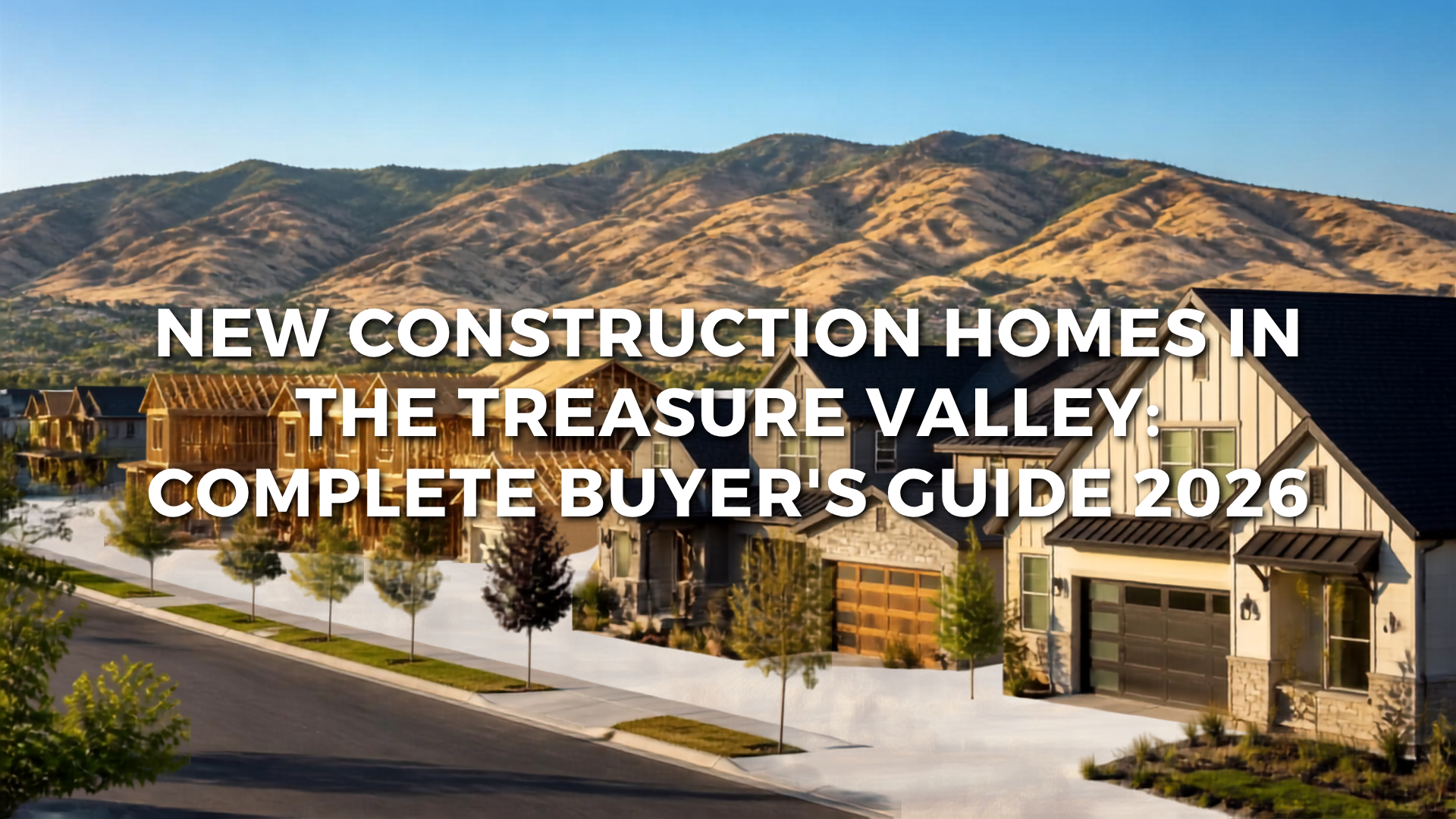
New construction isn't just a significant option in the Treasure Valley real estate market — it's the dominant force shaping it. In 2026, 43% of all home sales in the Treasure Valley are new construction homes . That number puts this market in a category of its own: nearly half of everything selling here was built recently, and Ada County new home closings are up 20% year-to-date, with builders keeping price growth modest at just 1% — with the average new home in Ada County at $669,022. If you're relocating from California, Oregon, or Washington and haven't seriously considered new construction, you're potentially overlooking the best-value option available to you in this market right now.
I have a Master's degree in Construction Management from USC and have specialized in new construction sales in the Treasure Valley for years. I've negotiated builder contracts, toured hundreds of model homes, reviewed builder reputations across the valley's 329 active subdivisions, and watched what happens when buyers walk into a sales office without an understanding of how this market works. This guide gives you everything you need to navigate new construction in the Treasure Valley with confidence — before you sit down with a single builder's sales agent.
For the contract-specific detail once you're ready to sign, the builder contract guide goes deep on deposits, preferred lenders, incentive value, warranty structure, and the pre-drywall inspection. This post covers the bigger picture: the market, the builders, the communities, and the decisions that determine whether you get a great new construction outcome or a frustrating one.
- Why New Construction Makes Sense Right Now
- The Three Types of New Construction — and Which One You're Actually Buying
- Treasure Valley Builders: Who's Building What and Where
- New Construction Communities by City
- Pricing by City and Price Band — Real 2026 Numbers
- Builder Incentives: What's Available and What It's Actually Worth
- The Preferred Lender Question
- Why You Need Your Own Agent
- Inspections on New Construction
- The Biggest New Construction Mistakes Buyers Make
- Frequently Asked Questions
Why New Construction Makes Sense Right Now
The case for new construction in the Treasure Valley in 2026 is stronger than in most markets and most moments. Here's why: builders are actively competing for buyers in a way they weren't during the peak frenzy of 2021 and 2022, when waitlists were standard and incentives were essentially non-existent. Today's buyers are being offered rate buydowns, closing cost credits, design center allowances, and included upgrade packages that weren't available two or three years ago. The rate buydown alone — often a 2/1 structure that drops your effective interest rate by two points in the first year and one point in the second — can make a meaningful difference to monthly payment that changes how much home you can comfortably afford.
New construction also solves a specific problem that resale buyers face in this market: condition risk. A new home has no deferred maintenance, no aging roof, no original-vintage HVAC unit approaching end of life, no electrical panel from 2003 that needs replacement. Everything is new, warranted, and built to current code. For buyers relocating from out of state who can't casually drive by a property to check on it between showings, the peace of mind of buying new — knowing what you're getting — has real value that doesn't appear in the price comparison.
The Three Types of New Construction — and Which One You're Actually Buying
Not all new construction is the same product, and the label "new construction" covers three distinct buyer experiences that have meaningfully different implications for timeline, customization, price, and risk.
Spec homes (standing inventory) are homes the builder has already started or completed without a buyer under contract. They're the closest to a resale transaction: you tour a home that either exists or is nearly complete, you can see the finishes, and the timeline to closing is short — often 30 to 90 days depending on completion status. Spec homes are where the best incentive packages typically live, because the builder is carrying an asset on their books and wants to convert it. They're also where negotiating leverage is highest: on a nearly completed spec that's been sitting 60 days, a motivated builder will often work harder on price, incentives, or both. The tradeoff is that finish selections have already been made — you get what's been built, and change order opportunities are limited or nonexistent.
To-be-built production homes are homes sold from a builder's standard plan library, on a lot the builder holds, with a selection process at the design center where you pick from the builder's pre-approved options for flooring, cabinets, countertops, fixtures, and exterior. This is the bread-and-butter new construction purchase in this market. Timeline is typically five to ten months from contract to closing depending on the builder, the phase, and the complexity of the home. You get real customization within the builder's design system — not unlimited, but meaningful. Incentives are available but typically not as aggressive as on spec standing inventory.
Full custom builds involve working with a custom builder on a lot you've either already acquired or that the builder holds, with a fully bespoke design process — your architect or the builder's design team, your selections across every element of the home, and a timeline that typically runs 12 to 18 months from contract to keys. This is the TerraView, Kingswood, and premium Eagle corridor experience. The price points are substantially higher, the process is substantially more complex, and the buyer input is substantially greater. Custom builds require a buyer who has the time, the patience, and the financial position to sustain a longer project without the certainty of a fixed price and timeline that a spec home provides.
Treasure Valley Builders: Who's Building What and Where
The Treasure Valley has 329 active subdivisions with over 5,883 new homes sold in the most recent annual survey. That's a lot of builders and a lot of product variety. Here's the landscape of who's building at each tier:
Production builders (volume, value, proven track record)
CBH Homes is the dominant production builder in this market by a significant margin — 35% of all new construction sales in the Treasure Valley are built by CBH Homes. That concentration reflects both their scale and their strategic positioning: they build across Ada and Canyon County, cover a wide price range ($350,000s to $600,000+), and run communities in Nampa, Caldwell, Kuna, Meridian, and parts of Boise. For buyers prioritizing value and a proven, well-understood process, CBH is the place to start. Their communities are well-distributed across the valley, their warranty process is established, and their sales process is straightforward. The tradeoff: CBH is production-minded, and the design options and finish levels reflect that. You're getting a consistent, reliable product, not a bespoke experience.
Hubble Homes is an award-winning builder serving communities across the full Treasure Valley — Boise, Meridian, Nampa, Caldwell, Kuna, Star, and Middleton. Hubble has built a strong reputation for quality construction and responsive customer service, with consistent recognition in regional builder awards. They tend to offer a step up in finish quality from the pure entry-level tier and have been consistently reliable on warranty follow-through in my experience working with their buyers.
Brighton Homes builds Energy Star Certified homes throughout the Treasure Valley with a focus on Meridian and Boise, emphasizing energy efficiency with Idaho's cold winters and hot summers specifically in mind. Brighton's communities tend to prioritize family-friendly amenities and West Ada School District access. Their J. Edwards division is the custom arm — and at a dramatically different price and quality level from their production product.
Mid-range to move-up builders
Blackrock Homes operates as one of Boise's premier production builders, with communities primarily in Meridian and Eagle. Their designs lean toward higher-end production building — more distinctive than standard tract homes but without the full custom build process. They appeal to move-up buyers who want something more elevated without the uncertainty and timeline of a full custom project.
Toll Brothers builds in the Treasure Valley through communities like Torrente in Eagle and Heirloom Ridge in Star. Toll Brothers is a national luxury production builder with a design center process that offers meaningful personalization within their product system. Their price points in this market typically run mid-$500,000s to $1.5 million depending on the community and floor plan. The Eagle and Star communities sit in a sweet spot between pure production and custom — more design input than CBH, significantly lower risk and faster timeline than a full custom build.
Custom and luxury builders
J. Edwards(Brighton's custom division), Biltmore Homes, Asprey Homes, Solitude Homes, Highland Custom Homes, and Bachman Homes are among the builders operating at the luxury and full custom tier, primarily in Eagle communities like TerraView, Valnova, Millstone Farm, and Kingswood Estates. These builders work within the ACC design standards of their communities and deliver the product and process that produces the homes in the $1.7 million to $4 million+ range covered in the TerraView home tour post.
New Construction Communities by City
The Treasure Valley's new construction activity is distributed across all of its major cities, with concentration in specific growth corridors. Here's the current active picture by city:
Meridian remains the single highest-volume new construction city in the valley, with communities active across all price bands from CBH entry-level in the $350,000s to Blackrock and Toll Brothers move-up product in the $700,000s to $1 million range. South Meridian and northwest Meridian are currently the most active corridors. West Ada School District access is the primary family driver here.
Eagle has the widest range of community types — from Torrente by Toll Brothers in the mid-$500,000s through TerraView luxury custom homes at $3 million or more. Key active communities include TerraView, Valnova, Millstone Farm, Torrente, Kingswood Estates, Avamor, and Dry Creek Ranch. Eagle commands the valley's highest prices and offers the most developed lifestyle amenities. The right choice for buyers who want the finished product now and can access the price point.
Star is growing at 14.7% annually — fastest in the valley — but available new construction is actually tighter than most buyers expect. Active communities include Heirloom Ridge (Toll Brothers), Cranefield, Cherished Estates, River Park Estates, Star River Ranch, and Lake Haven, plus a collection of small pocket communities of 8 to 12 lots that aren't visible on national search platforms. Highway 16's expected completion by end of 2026 makes buying in Star now a position ahead of an infrastructure improvement. Price ranges run mid-$500,000s through $2 million+.
Kuna is growing at 14.3% annually and offers some of the strongest value in Ada County for buyers who want new construction at more accessible price points. CBH Homes is the dominant builder here with multiple active communities. The presence of Meta's $800 million data center nearby is a long-term economic catalyst. Canyon County entry-level pricing makes Kuna one of the most compelling first-purchase communities in the valley.
Nampa and Caldwell offer Canyon County's most accessible new construction pricing. CBH, Hubble, and several regional builders are active throughout both cities. New construction in Nampa and Caldwell typically runs $320,000 to $500,000 for production homes, making these the best entry points for first-time buyers without California equity behind them.
Pricing by City and Price Band — Real 2026 Numbers
| City / Area | Entry New Construction | Mid-Range | Move-Up / Luxury |
|---|---|---|---|
| Meridian | $350,000–$480,000 | $480,000–$700,000 | $700,000–$1.2M+ |
| Eagle | $550,000–$700,000 (Torrente) | $700,000–$1.3M | $1.3M–$4M+ (TerraView) |
| Star | $530,000–$670,000 (Heirloom Ridge) | $670,000–$1M | $1M–$2M+ (River Park Estates) |
| Kuna | $320,000–$430,000 | $430,000–$560,000 | Limited |
| Nampa | $310,000–$420,000 | $420,000–$540,000 | $540,000+ |
| Caldwell | $300,000–$400,000 | $400,000–$500,000 | Limited |
Builder Incentives: What's Available and What It's Actually Worth
Builder incentives in 2026 are real, available across most price tiers, and worth understanding specifically rather than accepting at face value. Here's what's being offered and what each type actually means for your budget:
Rate buydowns are the most impactful incentive available right now in a mid-6% rate environment. A 2/1 buydown structure means your effective interest rate drops 2 points in year one and 1 point in year two before settling at the contract rate for the remaining loan term. On a $550,000 loan at 6.3%, a 2/1 buydown means you pay approximately 4.3% in year one and 5.3% in year two — a meaningful monthly payment difference in the period when cash flow matters most. A 3/2/1 buydown extends the savings window by a year. The real value calculation requires knowing how long you plan to stay and whether you're likely to refinance before the buydown period ends.
Design center allowances give you credit toward upgrades from the builder's catalog of finishes and options. A $15,000 design center allowance sounds like $15,000 — and it's less than that in real terms. Builder catalog items carry a markup over market cost, and any unused portion is forfeited rather than returned as cash. A $15,000 price reduction is worth more than a $15,000 design center allowance in every scenario: it lowers your financed amount, reduces your monthly payment, lowers the appraisal threshold, and doesn't expire unused.
Closing cost credits are close to full face value — they reduce your cash to close by the credited amount. Watch for lender caps on how closing costs can be applied; some loan types limit the credits a builder can provide toward closing costs.
Included upgrades vary widely in real value. An "included upgrade" is only worth the market cost of that specific item to you — if you would have selected it anyway, it has full value. If it's something the builder routinely includes in all homes in that tier as a marketing differentiator, the incremental value is zero.
The Preferred Lender Question
Almost every builder ties their most attractive incentive package to using their preferred in-house or affiliated lender. This is legal, common, and worth understanding clearly before you make any assumptions about what it means for you.
The builder's preferred lender exists partly to capture mortgage business and partly to give the builder more control over the transaction timeline. The lender's interest in the builder relationship is real, and that relationship may subtly influence how your file is handled at the margins. On rate and terms, the builder's lender may or may not be competitive relative to what an independent local lender would offer you — it varies significantly by builder and market moment. The correct approach: get a full pre-approval and rate quote from an independent local lender before you sign anything, then compare that against what the builder's lender is offering with the full incentive package included. Run the actual math — total cost of the loan over your expected hold period, including closing costs, rate, points, and the value of the incentive. Sometimes the builder's package wins clearly. Sometimes the outside lender, even without the incentive, produces a better outcome over five to seven years of ownership.
Why You Need Your Own Agent
This deserves to be said clearly because a meaningful number of buyers walk into builder model homes without their own representation and assume the builder's sales agent is looking out for them. The builder's sales agent is a skilled professional. They are also an employee of the builder whose job is to sell you a home from their employer on terms favorable to their employer. That's not a criticism — it's just the nature of the relationship. You need someone in the room whose job is specifically to look out for you, and that's what a buyer's agent with new construction experience provides.
In new construction, a locally experienced buyer's agent brings: knowledge of which builders have stronger versus weaker reputations for warranty follow-through, awareness of upcoming infrastructure improvements that affect specific communities' long-term value, understanding of which contract clauses have historically caused problems for buyers, the ability to compare incentive packages across builders with real experience of what each one actually delivers, and coordination of the pre-drywall and pre-closing inspection timeline. The builder pays the buyer's agent commission in most cases — this representation costs you nothing directly. Walking in without it is an information disadvantage from the first conversation.
Inspections on New Construction
New construction homes need independent inspections, and the specific inspection opportunities in a new build are different from resale. The inspections post covers the full picture; here's the new construction-specific summary:
The pre-drywall inspection is the most underutilized and most valuable inspection stage in the entire new construction process. It happens after framing, electrical rough-in, plumbing rough-in, and HVAC rough-in are complete but before walls are closed — the only point where an inspector can see the structural, mechanical, and electrical systems before they're permanently enclosed. Local inspection companies working in this market regularly find missing insulation, electrical wiring errors, plumbing joint issues, and framing problems at the pre-drywall stage that would never be detectable after the walls are finished. Budget for it. Schedule it. The window is narrow and timing-dependent on the builder's schedule — your agent needs to track construction progress and get your inspector in at the right moment.
The pre-closing inspection gives you the opportunity to document every incomplete, incorrect, or mismatched item before you take possession and create the punch list the builder is obligated to resolve. Bring your agent, bring the contract and design center selections for reference, and be thorough. Every item you miss before closing becomes a warranty claim process after — slower and more bureaucratic than getting it corrected before you hand over the balance of your purchase funds.
Add radon testing to every new construction inspection. The Treasure Valley's geology produces above-average radon concentrations regardless of whether the home is new or old. Idaho has no inspector licensing requirement — hire ASHI or InterNACHI-certified inspectors specifically.
The Biggest New Construction Mistakes Buyers Make
Walking into the sales office without a registered agent. The single most consequential and most preventable mistake. Register your agent before your first visit.
Accepting the first incentive package without comparison shopping. Builders' incentive packages vary significantly across companies, between spec inventory and to-be-built homes, and across different phases of the same community. Getting three or four independent lender quotes and comparing builders' full packages before you commit is worth the time.
Not getting a pre-drywall inspection. The single most impactful new construction-specific inspection and the one most buyers skip because it's not automatically scheduled — you have to ask for it and track the construction timeline to do it at the right moment.
Treating the incentive package comparison at face value. A $20,000 design center allowance is not equal to a $20,000 price reduction. A 2/1 rate buydown has a specific value that depends on your loan amount and hold period. Convert every incentive to its real value before you compare packages.
Confusing production-level finish expectations with custom results. Production builders build at scale with standardized processes. The model home you tour is typically built to a higher specification level than the base-price home you're signing a contract for. Ask specifically what finish level comes standard at the price you're being quoted versus what's an upgrade — and get those answers in writing before you sign.
Underestimating the timeline. A to-be-built home in a popular community runs five to ten months from contract to closing. If you're simultaneously selling a California home and coordinating a move, timeline slippage — common in new construction — can create expensive temporary housing situations. Plan conservatively, not optimistically. Have a backup housing plan ready before you need it.
Frequently Asked Questions
Is new construction a good option in the Treasure Valley in 2026?
Yes — new construction represents 43% of all Treasure Valley home sales in 2026, and Ada County new home closings are up 20% year-to-date. The current market combines meaningful builder incentives (rate buydowns, closing cost credits, design center allowances) with modest price appreciation of just 1% on the average Ada County new home ($669,022). For buyers relocating from out of state, new construction also eliminates the condition risk of resale — no deferred maintenance, no aging systems, a builder warranty, and current code compliance across every element of the home.
Who are the major new home builders in the Treasure Valley?
CBH Homes is the dominant production builder with approximately 35% of all new construction sales across the valley, building in communities from Caldwell to Meridian at price points from the $310,000s to $600,000+. Hubble Homes, Brighton Homes (Energy Star certified), and Blackrock Homes round out the production and mid-range tier. Toll Brothers builds in the $550,000 to $1.5 million range through Eagle and Star communities. At the custom and luxury tier, J. Edwards (Brighton's custom division), Biltmore, Asprey Homes, Solitude, Highland, and Bachman Homes serve the premium communities in Eagle including TerraView and Valnova.
What is the average price of a new construction home in the Treasure Valley in 2026?
The average new construction home in Ada County is currently $669,022, up just 1% year-over-year. Canyon County new construction runs meaningfully lower — typically $310,000 to $500,000 for production homes in Nampa, Caldwell, and Kuna. Price appreciation across new construction is projected at 3 to 4% for 2026, a significant stabilization from the pandemic-era volatility. Entry-level new construction in Canyon County starts around $300,000 to $320,000; luxury new construction in Eagle's premium communities starts around $1.7 million and extends to $4 million or more.
What are builder incentives in the Treasure Valley and how much are they worth?
Common builder incentives include 2/1 or 3/2/1 interest rate buydowns, closing cost credits ($5,000 to $20,000), design center allowances ($10,000 to $60,000 on standing spec), and included upgrade packages. Rate buydowns are typically the highest real-value incentive in the current 6%+ rate environment, meaningfully reducing monthly payments in the first one to two years. Design center allowances are worth less than their face value because builder catalog items carry markups and unused portions are forfeited — a price reduction of equivalent face value is always more valuable. Closing cost credits are close to full face value. Always convert every incentive to its actual value for your specific loan amount and hold period before comparing packages across builders.
Do I need a real estate agent to buy a new construction home?
Yes — and it costs you nothing directly, since the builder pays the buyer's agent commission in most Treasure Valley new construction transactions. The builder's sales agent works for the builder. A buyer's agent with new construction experience works for you, bringing knowledge of builder reputations, warranty track records, contract clause history, incentive real values, inspection timing, and infrastructure-aware community selection that the builder's sales team has no incentive to provide. Register your agent with the builder on or before your first visit to any sales office — most builders require first-visit registration for agent commission eligibility.
What inspections should I get on a new construction home?
Two inspection stages are essential. The pre-drywall inspection — after framing and mechanical rough-in but before walls are closed — is the only opportunity to evaluate structural, electrical, and plumbing systems before they're permanently enclosed. Local inspection companies regularly find missing insulation, electrical errors, and plumbing problems at this stage. The pre-closing inspection documents every item that isn't complete or correct before you take possession and creates the punch list the builder must resolve. Add radon testing to both stages — the Treasure Valley's geology produces above-average radon regardless of home age. Use ASHI or InterNACHI-certified inspectors; Idaho has no inspector licensing requirement.
New construction vs. resale — which is better in the Treasure Valley?
Both are strong options with different tradeoffs. New construction offers no deferred maintenance, current code compliance, builder warranty, energy efficiency, and the current incentive environment of rate buydowns and closing cost credits — at the cost of longer timelines (five to ten months for to-be-built), less established neighborhood character, and the risk that surrounding phases haven't built out yet. Resale offers established neighborhoods, mature landscaping, known community character, and often a faster transaction timeline — at the cost of unknown maintenance history, older systems, and no builder warranty. For out-of-state buyers who can't easily evaluate resale condition, new construction's predictability often tips the balance. For buyers who specifically want an established North End or river-corridor neighborhood character, resale is often the only option at that location and character level.
Key Takeaways
- 43% of all Treasure Valley home sales in 2026 are new construction. Ada County new home closings are up 20% year-to-date; average new home price is $669,022 — up just 1% — with 3 to 4% appreciation projected for the year.
- CBH Homes leads the market with 35% of all new construction sales. Hubble, Brighton, and Blackrock are the other major production and mid-range builders. Toll Brothers, J. Edwards, Biltmore, Asprey, and Solitude serve the premium and custom tier.
- Builder incentives are real and available: rate buydowns, closing cost credits, design center allowances. A design center allowance is worth less than its face value; a price reduction of equivalent amount is always more valuable. Convert every incentive to its real value before comparing packages.
- Always use an independent local lender for a competing quote before accepting the builder's preferred lender arrangement — the incentive may or may not offset any rate difference when compared over your actual hold period.
- Register your agent with the builder on your first visit to any sales office. Most builders require first-visit registration for commission eligibility.
- Get a pre-drywall inspection and a pre-closing inspection. Add radon testing. New construction homes in the Treasure Valley regularly produce significant findings that pass city inspections but don't meet quality standards.
- Understand the buildout phase of your community before you commit: how many additional homes in adjacent phases, what's adjacent land zoned for, what's the infrastructure improvement timeline for your access corridors.

Curtis Chism
Licensed Idaho Real Estate Agent • eXp Realty • License #SP56593
I have a Master's in Construction Management from USC and have specialized in new construction sales across the Treasure Valley for years. Let me help you navigate this market with the knowledge that comes from being inside it daily. Learn more at weknowtreasurevalley.com/about.
Ready to Explore New Construction in the Treasure Valley?
Let's talk through which builders, which communities, and which price bands actually make sense for your specific situation — before you walk into a single sales office.
Explore New Construction Call or Text: 208-510-0427