The question I get more than almost any other from new construction buyers is some version of: "Do I really need an inspection? It's brand new." I understand the logic. The home hasn't been lived in. Everything is under warranty. The city signed off on it. What is there to find?
Quite a lot, as it turns out — and consistently enough that every inspection company working in this market will tell you the same thing. I have a Master's degree in Construction Management from USC and spent years building residential and commercial projects in San Diego before I became a real estate agent. I've been on the builder side of this equation. I understand how job sites work, what happens when trades are under timeline pressure, and why new construction homes produce significant inspection findings with regularity — not because builders are cutting corners maliciously, but because construction at speed with multiple trades working simultaneously is a human endeavor with human error rates.
This post is specifically about why inspections on new construction matter, what they find that city inspectors don't catch, and how to use the two distinct inspection windows in a new build to protect yourself before the walls close and before you take possession. For the full inspection picture including resale homes, see the complete inspections post. For how inspections fit into the overall new construction process, see the step-by-step new construction guide.
- The "It's Brand New" Myth
- What City Inspections Actually Check
- What Third-Party Inspectors Actually Find on New Builds
- The Pre-Drywall Inspection: The Most Important Window You Have
- The Pre-Closing Inspection: Capturing Everything Before You Sign
- Radon on New Construction: Don't Skip This
- Sewer Scope on New Construction: Yes, Really
- How to Hire the Right Inspector in Idaho
- Inspections and Your Warranty Rights
- Frequently Asked Questions
The "It's Brand New" Myth
The assumption underneath "it's brand new, why inspect?" is that new homes are inspected thoroughly during construction by qualified people whose job is to catch problems. That's partially true — but only partially, and the gap between "partially true" and "fully true" is where buyers get hurt.
Here's the reality of how construction actually works. A production home in the Treasure Valley might take seven to nine months from groundbreaking to closing. During that time, dozens of subcontractors cycle through the site — framers, plumbers, electricians, HVAC contractors, insulation crews, drywall crews, tile setters, painters, finish carpenters. Each crew works under schedule pressure because builders are running multiple homes simultaneously and delays on one house create cascading delays on others. Coordination between crews is imperfect. The plumber roughs in pipes on Monday; the insulation crew comes Wednesday and sometimes insulates over areas that need to stay accessible. The electrician runs wire before framing is quite done and certain connections get made wrong. None of this is intentional negligence — it's the normal error rate of a complex, time-pressured multi-trade process.
In the Treasure Valley specifically, that error rate is elevated right now by labor market pressure. The Micron semiconductor expansion, Meta's data center construction, and the Gemstone Technology Park are pulling skilled trades away from residential construction at the same time residential production is running near its highest historical volume. The inspectors working in this market see the results of that pressure in their findings reports every week.
What City Inspections Actually Check
Every permitted new construction project in the Treasure Valley goes through a series of city inspections as the build progresses — rough framing, rough electrical, rough plumbing, rough HVAC, insulation, drywall, and final inspection. These inspections are real, they're required, and they matter. They're also not sufficient protection for a buyer's interests, for three specific reasons.
City inspectors check minimum code compliance — not quality. The International Residential Code sets minimum standards for framing, electrical, plumbing, and mechanical systems. A city inspector's job is to confirm that the home meets those minimums. It is not their job to evaluate workmanship quality, to flag installation choices that are technically code-compliant but below the standard a buyer would reasonably expect, or to catch issues that affect the buyer's interest specifically as opposed to public safety generally.
City inspectors move quickly. A single city inspector may cover multiple projects in a day. They spend minutes on each inspection, looking for specific code items, not conducting a comprehensive review of the entire assembly they're inspecting. A missing section of insulation in an exterior wall that isn't in their specific inspection focus area may not be caught. An incorrectly configured plumbing vent that technically produces code-compliant flow may not be flagged.
City inspectors answer to the city — not to you. Their job is to protect public safety and ensure code compliance on behalf of the jurisdiction that issued the permit. Their findings are the builder's disclosure to the city, not your disclosure as a buyer. An issue they catch is one the builder corrects for the permit — not necessarily one you're informed about as the purchasing party. Your interests in this transaction are specifically yours, and representing them requires someone who answers specifically to you.
What Third-Party Inspectors Actually Find on New Builds
Local inspection companies working in this market consistently produce significant findings on new construction homes. These aren't anecdotal exceptions — they're the regular results of qualified inspectors doing thorough pre-drywall and pre-closing evaluations on new homes built by reputable builders in active communities. Here's what shows up most consistently:
Missing insulation. This is the most commonly cited new construction finding by local inspection companies, and it requires a thermal camera to detect reliably in finished homes. Exterior wall cavities where insulation wasn't installed before drywall — sometimes due to miscommunication between the insulation crew and the drywall schedule, sometimes due to access issues around rough electrical or plumbing — appear as cold spots on thermal imaging that are completely invisible to the naked eye once walls are finished. In Idaho's climate where winter lows drop into the teens and summer highs push past 100°F, missing insulation directly affects your energy bills every month for as long as you own the home. It's a straightforward fix when caught at pre-drywall. It's a drywall demolition project when discovered after closing.
Improper window and door sealing. Gaps and voids in window and door rough openings — around the frame, at flashing transitions, at the interface between the window unit and the exterior sheathing — are common findings. They allow drafts, can allow water intrusion over time, and directly affect thermal performance. Again: straightforward fix before the exterior is finished, significant remediation project afterward.
Roof flashing errors. Incorrectly installed flashing at roof-wall intersections, at penetrations, and at valleys is one of the more consequential new construction findings because water intrusion from flashing failures typically isn't discovered until it's caused damage — sometimes years after closing. The pre-closing inspection can identify surface signs of potential flashing issues; the pre-drywall inspection can sometimes see flashing details at the rough stage. This is an area where an inspector's experience with Idaho roofing specifically matters.
Plumbing joint leaks and disconnected vents. Leaking joints at under-sink plumbing connections, improperly connected drain-waste-vent configurations, and plumbing vents that weren't properly connected before drywalling are regular findings. A disconnected plumbing vent in a new home doesn't create an immediately visible problem — it creates a long-term sewer gas intrusion risk and drainage performance issue that shows up months or years after move-in. Finding it during the pre-drywall inspection is straightforward. Finding it with a sewer scope after closing is the right diagnostic but not a moment anyone wants.
Electrical wiring errors. Reversed polarity on outlets, improperly wired three-way switches, missing AFCI or GFCI protection where required by current code, and circuit configurations that don't match the panel schedule are regular electrical findings on new builds. These are safety issues in addition to functionality issues — and they're the category most likely to pass a city inspection focused on rough wiring while still producing buyer-side findings at a detailed walkthrough level.
Grading problems. The finished grade around the foundation — how steeply the soil slopes away from the house versus toward it — is critical for long-term foundation performance and water management. Production homes built quickly sometimes end up with grading that directs surface water toward the foundation rather than away from it. In the Treasure Valley's clay-heavy soil conditions in some areas, water pooling against a foundation creates both moisture risk and expansive soil movement risk. This finding is visible to a qualified inspector on a pre-closing walkthrough and is typically an easy correction before you take possession — and a progressively harder one over subsequent years as landscaping and hardscaping are established around it.
The Pre-Drywall Inspection: The Most Important Window You Have
There are two distinct inspection opportunities in any new construction purchase. Most buyers know about the pre-closing inspection. Far fewer take advantage of the pre-drywall inspection — and of the two, the pre-drywall is the more valuable one by a significant margin.
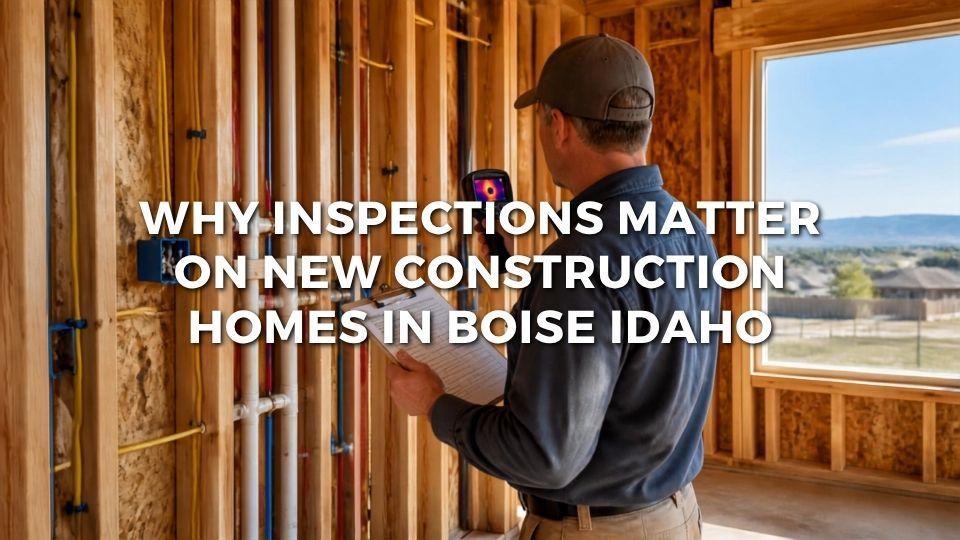
The pre-drywall inspection happens after framing, electrical rough-in, plumbing rough-in, and HVAC rough-in are complete but before drywall is delivered and hung. This is the only point in the entire construction process when a qualified inspector has full visual access to every structural, mechanical, and electrical element of the home simultaneously. The framing connections, the electrical wire routing, the plumbing configuration, the HVAC ductwork, the insulation cavities — all of it is visible at once, nothing hidden behind finished surfaces.
This window is typically open for only a few days. Once drywall delivery is scheduled, the window closes. Catching it requires your agent to be actively tracking the construction schedule and coordinating the inspector's availability at the right moment. For out-of-state buyers, this is one of the specific situations where having a locally active agent managing the build process on your behalf makes a concrete, measurable difference — because a missed pre-drywall window can't be reopened.
The Pre-Closing Inspection: Capturing Everything Before You Sign
The pre-closing inspection — conducted one to two weeks before your closing date — is the second inspection window and the one most buyers are already planning for. Its job is different from the pre-drywall inspection: rather than evaluating systems that are still exposed, it evaluates the finished home against what was promised in the contract and the design center selections, and identifies any workmanship, condition, or completion issues before you take possession and your leverage shifts.
Every item identified at the pre-closing inspection goes onto a punch list — a formal list of items the builder is obligated to correct before or shortly after closing. Your leverage is highest while the builder still wants your closing to happen on schedule. After closing, unresolved punch list items become warranty claims, which move through the builder's warranty department on their timeline rather than yours. The pre-closing inspection is not a casual walkthrough — it's a formal documentation of everything that isn't complete, correct, or consistent with what was contracted.
Bring your contract and your design center selection sheet to this inspection. Confirm that every upgrade you paid for was actually installed — the specific flooring you selected in the primary bedroom, the tile you chose in the primary bath, the hardware finish you picked for the kitchen cabinets. These discrepancies happen. They're almost always correctable before closing if caught at this inspection. They're sometimes contested and sometimes not fully resolved if discovered after you've moved in.
Radon on New Construction: Don't Skip This
Radon is a naturally occurring radioactive gas produced by uranium decay in soil and rock that seeps into homes through foundation penetrations, construction joints, and any gap between the home and the ground. It's the second leading cause of lung cancer in the United States after smoking. Idaho has above-average radon concentrations relative to the national baseline due to regional geology, and the Treasure Valley specifically produces elevated radon readings with enough regularity that both the Idaho DEQ and local inspection companies specifically flag this area as higher risk.
New construction is not exempt from radon risk. The soil conditions beneath the home determine the radon concentration, and a newly poured concrete slab doesn't change what's in the ground underneath it. A brand-new home sitting on high-radon geology will have elevated radon if it hasn't been mitigated — and standard production builders don't typically include radon mitigation unless it's requested or required by the community's covenants. Radon testing costs $150 to $300 as an add-on to a standard inspection. The EPA action level is 4 picocuries per liter. If testing finds levels above that threshold — which it does with regularity in this market — a sub-slab depressurization system runs approximately $800 to $1,500 installed. Test before closing. The builder is responsible for addressing findings discovered before closing in a way they are not responsible for findings discovered after.
Sewer Scope on New Construction: Yes, Really
A sewer scope inspection runs a camera through the main sewer lateral from the home to the city connection, checking for blockages, improper pitch, separations, and installation errors. Tree root intrusion — the most common resale sewer scope finding — obviously isn't relevant on a new home. What is relevant is incorrect installation: a sewer lateral that doesn't have sufficient slope to drain correctly, a disconnected joint that won't be evident from inside the home until it fails, or a pipe section that wasn't properly bedded in the trench and has already begun to deform under backfill pressure.
Local inspection companies in the Treasure Valley actively recommend sewer scopes on new construction because they find problems on new homes with enough regularity to justify the $150 to $300 cost. The argument is simple: if a disconnected sewer lateral is discovered before closing, the builder corrects it. If it's discovered after closing when the system fails, you're dealing with a warranty claim process and potentially excavating your front yard while you've already moved in and your family is living around the disruption. Test before closing.
How to Hire the Right Inspector in Idaho
Idaho has no state licensing or certification requirement for home inspectors. Anyone can legally call themselves a home inspector in Idaho regardless of their training, experience, or qualifications. The quality variance between inspectors is real and it matters — specifically for new construction, where the inspection requires understanding of construction sequencing, code requirements, and the specific failure modes of fast-paced residential builds.
Look for ASHI (American Society of Home Inspectors) or InterNACHI (International Association of Certified Home Inspectors) certification specifically — these organizations have their own training, examination, and continuing education requirements that the state does not impose. Ask whether the inspector uses a thermal imaging camera, which is essential for detecting missing insulation and moisture intrusion in finished homes. Ask specifically about their experience with new construction inspections in the Treasure Valley — an inspector whose primary background is resale home inspection will not have the same construction sequence literacy that a pre-drywall inspection requires.
Do not use an inspector recommended by the builder. Even well-intentioned builder-recommended inspectors carry a structural conflict of interest in that they value their ongoing relationship with the builder's referral. Your inspector should answer to you exclusively. Get referrals from your agent — a locally active agent who handles new construction regularly will have relationships with certified inspectors who do excellent work on pre-drywall evaluations specifically.
Inspections and Your Warranty Rights
New construction homes in Idaho typically come with what's called a 1-2-10 structural warranty: one year of coverage on workmanship and materials, two years on mechanical systems (plumbing, electrical, HVAC), and ten years on structural defects. These warranties sound comprehensive — and relative to buying a resale home with no warranty, they are a genuine advantage. But they have important nuances that make the inspections matter even more, not less.
Warranty claims require specific notice procedures — typically written notice within a specific timeframe after discovery of the issue. Failing to follow the notice procedure can void your claim on a legitimate defect. Warranty claims also shift the remediation process to the builder's warranty department, which operates on its own timeline. A builder who is highly responsive during the sales process may be significantly less responsive once your check has cleared and you're a warranty claim rather than a pending sale.
Perhaps most importantly: most warranty claims require you to demonstrate that the defect exists and that you notified the builder in writing within the covered period. An inspection report from a qualified third-party inspector, conducted before closing, creates a documented baseline of the home's condition that supports your warranty position. If a problem emerges two years after closing and you have a pre-closing inspection report that documents relevant conditions at that time, your warranty position is significantly stronger than if you have no documentation.
Frequently Asked Questions
Do I need an inspection on a brand new home?
Yes — absolutely and without qualification. New construction homes in the Treasure Valley regularly produce significant inspection findings including missing insulation, electrical wiring errors, plumbing connection problems, grading issues, and roof flashing concerns that pass city inspections but aren't at the quality standard a buyer should accept. Idaho's labor market pressure from semiconductor and data center construction has elevated the error rate further. The cost of fixing these issues before closing is a fraction of the cost of fixing them as post-closing warranty claims or self-funded repairs. Budget approximately $350 to $550 for a standard inspection plus add-ons for radon ($150 to $300) and sewer scope ($150 to $300).
What is a pre-drywall inspection on a new construction home?
A pre-drywall inspection is conducted after framing, electrical rough-in, plumbing rough-in, and HVAC rough-in are complete but before drywall is installed — the only point in the build when all structural, mechanical, and electrical systems are simultaneously visible. It's the most valuable inspection window in new construction because issues found at this stage are corrected before they're permanently enclosed, at a fraction of the cost of post-closing remediation. The window is typically only open for a few days before drywall delivery; catching it requires your agent to be actively tracking the construction schedule and coordinating your inspector's availability.
Is radon a concern in new construction homes in the Treasure Valley?
Yes. Idaho has above-average radon concentrations due to regional geology, and new construction is not exempt — the soil beneath the slab determines the radon level, not the age of the home. Radon testing regularly finds levels above the EPA action level of 4 picocuries per liter in new Treasure Valley builds. Testing costs $150 to $300 as an add-on to a standard inspection. If levels are elevated, a sub-slab depressurization system runs $800 to $1,500 installed. Test before closing — the builder addresses pre-closing findings; post-closing radon remediation is entirely your cost and your responsibility.
Do I need a sewer scope on a new construction home?
Yes — local inspection companies working in this market actively recommend sewer scopes on new builds because they find problems with enough regularity to justify it. Tree root intrusion isn't relevant on a new home, but incorrect installation — improper pipe slope, disconnected joints, improperly bedded pipe — is a real risk that a camera inspection finds before it causes a failure inside the home. The inspection costs $150 to $300 and the findings are the builder's responsibility to correct before closing. Discovering the same problem after closing creates a warranty claim process and potentially a landscaping excavation project after you've moved in.
Who should I hire for a new construction inspection in Boise Idaho?
Look specifically for ASHI or InterNACHI-certified inspectors — Idaho has no state licensing requirement for inspectors, and quality varies dramatically. Verify that the inspector uses a thermal imaging camera, which is essential for detecting missing insulation and moisture issues in finished homes. Ask specifically about their experience with new construction pre-drywall inspections, which require different expertise than resale inspection. Don't use an inspector recommended by the builder — even well-intentioned referrals carry a structural conflict of interest. Get referrals from your agent, who should have established relationships with inspectors who specialize in new construction in this market.
What does the 1-2-10 builder warranty cover on a new home?
The 1-2-10 structural warranty covers one year on workmanship and materials, two years on mechanical systems (plumbing, electrical, HVAC), and ten years on structural defects. Warranty claims require specific written notice procedures — failing to follow them can void a legitimate claim. The warranty also covers the builder, not you specifically, and a pre-closing inspection report from a qualified third-party inspector creates documented evidence of the home's condition at closing that significantly strengthens your warranty position if problems emerge later. Idaho law also provides implied warranties of habitability and workmanlike construction independent of the builder's written warranty.
Key Takeaways
- New construction homes produce significant inspection findings regularly in this market — missing insulation, electrical errors, plumbing issues, grading problems, and flashing concerns are all common. Labor market pressure from semiconductor and data center construction has elevated the error rate further.
- City inspections confirm minimum code compliance on behalf of the jurisdiction. They don't represent your interests as a buyer, evaluate workmanship quality beyond code minimums, or ensure that everything you paid for was actually installed. City inspection and buyer-side third-party inspection are complementary — not redundant.
- The pre-drywall inspection is the most valuable inspection window in new construction — the only point when all structural, mechanical, and electrical systems are visible before permanent enclosure. The window is open for only a few days; catching it requires active construction timeline tracking by your agent.
- Radon testing is not optional in this market. Idaho has above-average radon due to regional geology, and new homes are not exempt. Test before closing; the builder addresses pre-closing findings. Post-closing radon remediation is entirely your cost.
- Get a sewer scope on new construction. Incorrect installation — improper pitch, disconnected joints — is found on new builds with enough regularity that local inspection companies specifically recommend it.
- Idaho has no state licensing requirement for home inspectors. Hire ASHI or InterNACHI-certified inspectors with a thermal imaging camera and specific new construction experience. Don't use a builder-referred inspector.
- A pre-closing inspection report from a qualified third-party inspector creates the documented baseline that strengthens your warranty position if problems emerge in years one or two after closing.
- Budget $650 to $1,150 for a complete new construction inspection package: standard inspection ($350–$550) + radon test ($150–$300) + sewer scope ($150–$300). On a $500,000+ purchase, this is the highest-ROI expenditure in the entire transaction.

Curtis Chism
Licensed Idaho Real Estate Agent • eXp Realty • License #SP56593
Master's in Construction Management from USC. I've managed construction projects and now represent buyers through them. Inspections are one of the most important parts of this process and I make sure my clients don't skip them. Learn more at weknowtreasurevalley.com/about.
Buying New Construction in the Treasure Valley?
I'll make sure your inspection windows are scheduled correctly, your inspector is certified and equipped, and every finding gets properly documented before you close.
Explore New Construction Call or Text: 208-510-0427