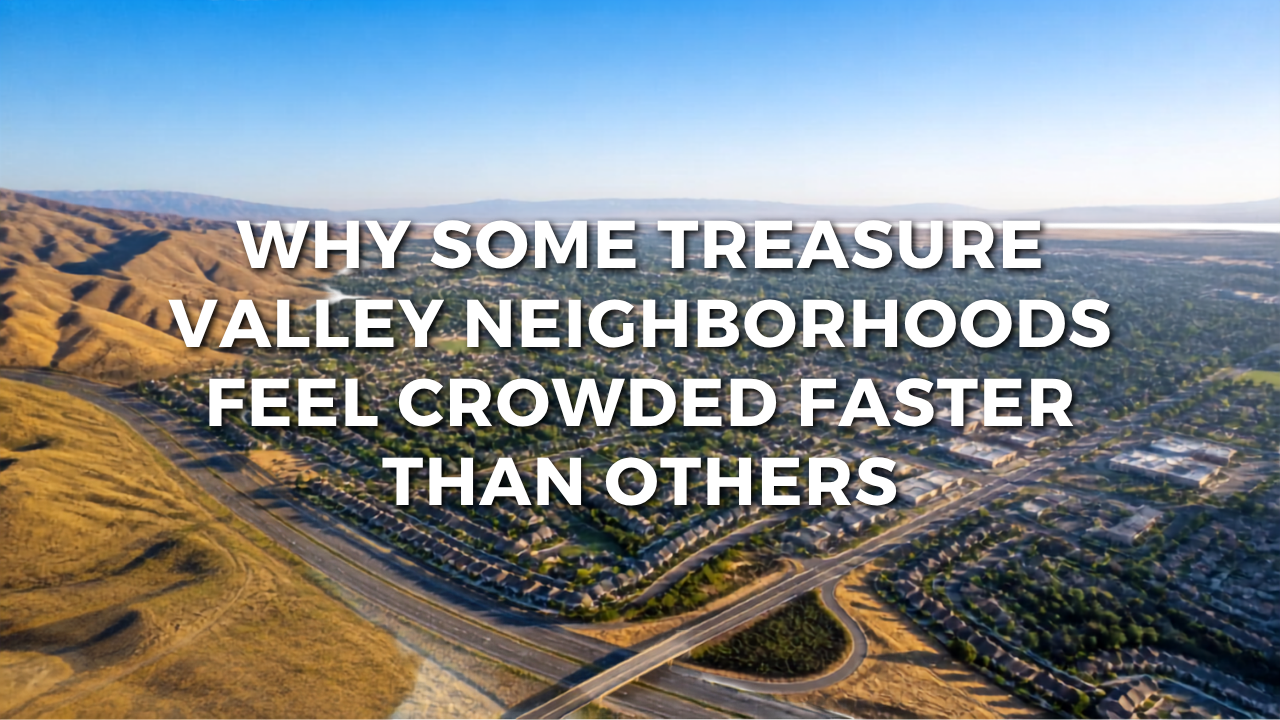
One of the more common things I hear from buyers who've been in the Treasure Valley for a year or two is some version of this: "It feels so much more crowded than when I moved here." And what they almost always mean isn't that they're surrounded by more people overall — it's that their specific part of the valley feels different. More cars on their road. More houses on the lots around them. More construction noise. More time in traffic. The community they bought into feels less like what they thought they were buying.
This isn't random. Some areas absorb growth in a way that's barely noticeable for years. Others feel the density pressure almost immediately. The difference comes down to a specific set of factors — infrastructure design, lot sizing standards, geographic constraints, zoning patterns, and the order in which development happens — and understanding those factors before you buy is one of the most underappreciated advantages a buyer can have in this market. This post explains exactly what drives the crowded feeling and how to use that knowledge to pick the right neighborhood before you sign anything.
- The Road Network Was Built Before the Growth
- Lot Sizes Set the Density Permanently
- Geography Traps Growth — or Spreads It
- Zoning Patterns and the Mixed-Use Squeeze
- Arterial Roads: The Invisible Bottleneck
- Development Phase Order Matters More Than You Think
- Green Space and What Happens When There Isn't Any
- How This Plays Out Across the Treasure Valley
- What to Look For Before You Buy
- Frequently Asked Questions
The Road Network Was Built Before the Growth
The most common reason a neighborhood starts to feel crowded is that its road network was designed for a fraction of the population it's now serving. This isn't unique to Idaho — it's how suburban development has happened across the American West for decades. A farm road becomes an access corridor for one subdivision. The subdivision sells out. Another subdivision gets built down the road using the same corridor. Then another. Suddenly a two-lane road designed for agricultural traffic is handling the daily commute of several thousand households, and nobody budgeted to widen it because each individual development's traffic impact, reviewed in isolation, looked manageable at the time.
This is exactly what happened to Highway 44 in Star, to Eagle Road through Meridian, and to Chinden Boulevard through the northwest corridor. The roads preceded the density in some cases. In others, the density grew around them before anyone fully modeled the cumulative effect. The result is a small number of arterial corridors absorbing an enormous share of the valley's movement, and communities that sit between those corridors feeling the pressure first.
Lot Sizes Set the Density Permanently
This is the one that's hardest to visualize when you're standing in a sales model looking at a beautiful floor plan. The lot the home sits on determines how many people can live per acre in that community forever. You can't go back and add space between the houses once they're built. The density a community launches with is the density it keeps, and that density determines how quickly it feels crowded as the surrounding area continues to develop.
Standard new construction lots in most Treasure Valley communities run 6,000 to 8,500 square feet. At that lot size, you can fit roughly five to seven homes per acre depending on how streets and common areas are laid out. Compare that to a community with 10,000 to 15,000 square foot lots, which might house three to four homes per acre — meaningfully less density, noticeably more space per household, and a different long-term feel. The communities in the Treasure Valley that have maintained the most livable feel over time as growth has intensified tend to be the ones that launched with larger average lot sizes, because the breathing room was built in structurally rather than assumed.
Geography Traps Growth — or Spreads It
The Treasure Valley sits in a basin. Its usable residential land is bounded on the north and east by the Boise Foothills (development gets increasingly difficult past a certain elevation), on the south by the Snake River Plain (flat, but distance limits practical commuting), and the geography of the Boise River creates corridors that channel development rather than spread it evenly. That geography doesn't constrain all communities equally.
Communities that sit against a natural boundary — the foothills, a river corridor, a large agricultural preserve — on at least one side tend to experience more controlled growth around their edges. Communities that sit in the middle of open developable land on all sides tend to absorb pressure faster because there's no natural stop to adjacent development. Eagle's river-adjacent neighborhoods feel different from Eagle's inland ones for exactly this reason — the river provides a fixed boundary that limits how much can be built directly adjacent to it. Meridian's central location, surrounded by developable land in every direction, has made it the valley's growth absorption center — which is both why it has great amenity access and why some corridors have congested faster than its residents expected.
Zoning Patterns and the Mixed-Use Squeeze
Zoning determines what can be built where, and zoning decisions made years before a neighborhood's population arrived can produce dynamics that feel invisible at purchase time and very visible five years later. The most common version: residential neighborhoods built adjacent to commercial or industrial land that was, at the time of the homes' construction, undeveloped. The homes go in, people move in, the empty commercial parcel is quiet. Then the commercial development arrives — a retail strip, a distribution center, a big-box development — and suddenly the neighborhood that felt private and quiet is bounded by traffic, lighting, and activity it didn't account for.
This isn't inevitable, but it's common enough to be worth specifically investigating before you buy. Ask your agent: what is the zoning of the parcels adjacent to this community? What is planned for the undeveloped land to the north, south, east, and west? City planning departments maintain that information and it's public record — a good agent should be able to pull current zoning maps and identify what's likely coming before you commit. The commercial development along Beacon Light Road adjacent to Terraview and Valnova in Eagle is a positive example — high-end commercial that will add walkable amenities — but the same proximity to commercial zoning that produces that outcome can just as easily produce a less desirable one in a different context.
Arterial Roads: The Invisible Bottleneck
Not all roads feel the same amount of growth pressure, and the specific roads a neighborhood depends on for daily access matters more than overall proximity to a major corridor. The Treasure Valley's growth has concentrated traffic on a small number of arterial roads — Eagle Road, Chinden Boulevard, Ten Mile Road, Highway 44, and McMillan Road — in ways that residents who bought expecting a 15-minute commute now experience as a 35-minute one during peak hours. But the pressure isn't uniform even on those corridors. A neighborhood with a freeway interchange nearby has multiple access options. A neighborhood entirely dependent on a single two-lane arterial with no alternative routes is far more exposed to congestion degradation over time.
When you're evaluating a specific community, look at how many ways in and out it has, which roads those exits connect to, and how those roads are projected to handle growth. The COMPASS 2040 projections covered in the how far should you live from Boise post show specific commute time increases by corridor that make this very concrete. The Caldwell-to-Boise commute has nearly doubled over the past decade on the Chinden corridor. The same volume-to-capacity stress that drove that outcome is replicating itself on other corridors as growth continues.
| Corridor | Current Status | Trajectory |
|---|---|---|
| Eagle Road (Meridian N-S) | Heavy peak congestion | Widening underway; volume pressure continuing with growth |
| Chinden Blvd (E-W) | Significant congestion; doubled over decade | SH-20/26 widening ongoing; continued pressure likely |
| Highway 44 (Star) | Rush-hour congestion especially westbound | HWY 16 extension (late 2026) will provide meaningful relief |
| Ten Mile Road (Meridian) | Growing pressure; moderate now | Significant residential buildout continuing west of Ten Mile |
| Highway 16 (new N-S) | Under construction | Substantial completion late 2026; relief valve for NW corridor |
Development Phase Order Matters More Than You Think
Master-planned communities in the Treasure Valley are often built in phases — sometimes five, sometimes nine, sometimes fifteen phases over a decade or more. Where you buy within that phase sequence matters significantly to how the community feels in the years immediately after you move in, and it's something most buyers don't specifically ask about.
Buying in the first phase of a large community means you move into a relatively uncrowded development — but it also means you're surrounded by active construction for the next several years as subsequent phases build out. Your street is done. The streets around you are under active work. The noise, the construction traffic, the dust, and the interruption to roads and utilities happen in your backyard for a while. Buying in a later phase means the community around you is more mature, but you're paying a higher price (lot costs in most Treasure Valley master-planned communities increase phase by phase as the community proves out) and the surrounding development timeline is longer. There's no universally right answer — it depends on your tolerance for construction activity and your price sensitivity — but understanding where a community is in its buildout before you buy is information worth having.
Green Space and What Happens When There Isn't Any
Neighborhoods with meaningful common green space built into their layout — parks, trails, open areas maintained by the HOA or the city — feel fundamentally less crowded than neighborhoods of equivalent density without it. This sounds obvious, but the mechanism matters: green space doesn't just provide recreation. It provides visual relief from density, a gathering point that distributes where residents go so they're not all funneling through the same corridors, and a noise and activity buffer between built areas. A neighborhood where you can walk to a park in three minutes feels less crowded than one of equal lot density where everything exits onto the same road.
The communities in the Treasure Valley that have maintained the strongest community feel as they've grown — Julius M. Kleiner Memorial Park in Meridian, the Greenbelt corridor through Eagle and Boise, Settlers Park, the trails in Star along the river — do so in part because the green space infrastructure distributes the pressure of density rather than concentrating it. When you're evaluating a community, look specifically at what dedicated open space is deeded in the plat — not just what's undeveloped land that could eventually be built on, but what's actually preserved and maintained as common area within the neighborhood itself.
How This Plays Out Across the Treasure Valley
Here's how these dynamics show up in specific places you may be evaluating:
Meridian central corridors feel more crowded than they did five years ago primarily because of the Eagle Road and Chinden bottlenecks — the roads haven't kept pace with the residential and commercial buildout on either side. Meridian's size and central location mean it's absorbing growth from multiple directions simultaneously, and the arterial network is running at or near capacity during peak hours in several key spots. This doesn't make Meridian a bad choice — it's still one of the strongest overall packages in the valley — but it makes the specific neighborhood's relationship to those corridors important. A home near the Ten Mile interchange feels materially different from one requiring Eagle Road for every errand.
Star's Highway 44 corridor is the clearest current example of a road not built for the volume it now carries. The city has grown 131% since the 2020 census and the primary access road is a two-lane highway with at-grade intersections that wasn't designed for a city of 25,000+. The growth is real and the friction is real — but it's specifically a road infrastructure problem rather than a density problem, and Highway 16 is a specific, funded, under-construction solution to it with a confirmed timeline.
Canyon County's western cities — Caldwell and areas beyond — have the least geographic constraint on development but the longest commute corridors, which is why the I-84 and Chinden approaches have seen the largest absolute travel time increases over the past decade. The land is available, homes are affordable, and development has absorbed those access constraints rather than being limited by them — but that means buyers there are experiencing the full effect of having grown faster than the road network designed to serve them.
Eagle's river-adjacent communities have aged better in terms of crowded feeling than most equivalently-aged suburban development in the valley, largely because the Boise River creates a hard boundary on one side that structurally limits adjacent development. You can't build across the river in most configurations. That constraint is a feature for long-term livability, not an oversight.
What to Look For Before You Buy
Before you commit to a specific community or neighborhood, here are the specific questions I walk clients through that address the crowding trajectory — not just what the neighborhood feels like today, but what it will likely feel like in five years.
How many exits does this community have, and which roads do they connect to? A community with one road in and one road out is exposed to any failure or congestion on that corridor. Multiple access points to multiple roads is structural insurance against degradation.
What is the current zoning of undeveloped parcels adjacent to this community? Ask your agent to pull the city's zoning map for the parcels that surround the neighborhood on all sides. Commercial zones near residential communities aren't automatically bad, but they deserve scrutiny. Agricultural land adjacent to a neighborhood will eventually develop — knowing the zone tells you something about what it will become.
What is the average lot size, and how does that compare to the surrounding development? Standard 6,000 to 7,000 square foot lots in a community surrounded by similar density will maintain their relative character. But if your community is the higher-density one in an area where surrounding development is also high-density, the cumulative road pressure will arrive faster than if you're in a lower-density community with more space around it.
Where is this community in its buildout phase, and what's coming in the adjacent phases? Ask the builder or developer specifically — how many total phases, what's the current phase, and what will be built in the lots immediately adjacent to yours in the next two to three phases. Knowing that construction is coming to your immediate north for the next three years is different from discovering it after you move in.
Is there preserved common green space within the community, and is it deeded as such?"Future park" on a site plan is not the same as "deeded common area permanently maintained by the HOA." Ask specifically which open areas are legally protected as common space and which are simply undeveloped lots that could be built on later.
Frequently Asked Questions
Why do some Treasure Valley neighborhoods feel more crowded than others?
The crowded feeling in a neighborhood isn't just about how many people are there — it's about how well the infrastructure was designed to handle the density. The primary drivers are road network capacity relative to traffic load, lot size standards that determine permanent density, geographic constraints that limit or channel growth on adjacent land, zoning patterns that determine what gets built nearby, the number and condition of access points in and out of the community, and whether meaningful green space was built into the neighborhood's layout. Communities that addressed these factors proactively maintain a more livable feel as the surrounding valley continues to grow.
Which Treasure Valley suburbs are least affected by crowding and congestion?
Communities with natural geographic boundaries on at least one side — river-adjacent Eagle neighborhoods, foothills-adjacent communities in North Boise and parts of Star — tend to maintain a more livable feel over time because development cannot encroach from those directions. Communities with freeway interchange proximity (rather than single-corridor dependence) also age better from a commute standpoint. Smaller, lower-density communities with larger average lot sizes maintain more of their character as surrounding areas develop. The specific examples that have held up best: the Boise River corridor through Eagle, foothill-adjacent communities in Star and North Boise, and Meridian neighborhoods positioned near multiple access routes rather than dependent on a single arterial.
How do I know if a neighborhood will feel crowded in five years?
Before buying, investigate: the current zoning of adjacent undeveloped parcels, the average lot size and density compared to surrounding areas, how many access routes the community has and the current traffic load on those roads, where the community sits in its buildout phase and what will be built in adjacent phases next, and whether there is deeded common green space within the layout. COMPASS publishes traffic projections and long-range transportation data for the Treasure Valley that provides specific corridor-level guidance. A good local agent who follows development patterns closely can walk through all of this for the specific community you're evaluating.
Why has the commute gotten worse in parts of Meridian and Eagle?
Residential and commercial buildout on both sides of Eagle Road and Chinden Boulevard has significantly outpaced the road network's capacity to serve the resulting traffic. The Chinden corridor specifically has seen travel times roughly double over the past decade as the northwest Meridian and Eagle corridor absorbed enormous population growth. The road network in both cities was designed before the full scope of that growth was clear, and while widening projects are underway on multiple segments, the expansion has consistently run behind the pace of development. Neighborhoods that depend primarily on these corridors for access have experienced the most significant degradation in commute quality.
Does lot size affect how a neighborhood feels long-term?
Yes — significantly and permanently. Lot size determines the density of a community for its entire lifespan. A neighborhood built on 6,000 square foot lots with five-foot side setbacks will always be denser than one built on 10,000 to 12,000 square foot lots with more separation between homes. As the surrounding area grows and traffic on access roads increases, the denser community absorbs more people per acre contributing to that traffic load. Lower-density communities with larger lots tend to maintain their character more effectively as growth pressure builds around them, because the breathing room was structural rather than assumed.
What is COMPASS and why does it matter for Treasure Valley buyers?
COMPASS — the Community Planning Association of Southwest Idaho — is the regional planning agency that coordinates transportation, land use, and growth planning across Ada and Canyon counties. It publishes population projections (it's the source for the 915,940 April 2026 figure and the 1.1 million by 2050 projection), traffic volume counts, and long-range transportation improvement plans that identify which corridors will face the most pressure under different growth scenarios. For buyers trying to understand the long-term trajectory of a specific neighborhood's commute and crowding dynamics, COMPASS data is the most authoritative source available.
How does Highway 16 affect crowding in Star Idaho?
Highway 16's extension — expected to substantially open by late 2026 — creates a new north-south limited-access route through the Star corridor that doesn't currently exist. Star's primary access challenge is Highway 44, a two-lane road that wasn't built for a city of 25,000+ and is now carrying the traffic of one. Highway 16 provides an alternative north-south route that pulls traffic off Highway 44, reduces average commute times from Star to Eagle, Boise, and I-84, and structurally improves access capacity for the entire northwest corridor. Buyers in Star before its opening are buying at prices that reflect the current friction — the infrastructure improvement is a known, confirmed, funded catalyst rather than speculation.
Key Takeaways
- The crowded feeling in a neighborhood is driven by identifiable, structural factors — road capacity relative to traffic load, lot size density, geographic constraints, zoning of adjacent land, access point count, and green space — not just by general population growth.
- Lot sizes set community density permanently. A neighborhood launched at standard 6,000–7,500 sq ft lots will always be denser than one with 10,000–15,000 sq ft lots, and that density difference compounds as surrounding areas develop.
- Communities with natural geographic boundaries on at least one side — rivers, foothills — tend to maintain their character better over time because development cannot encroach from those directions.
- Eagle Road, Chinden Boulevard, and Highway 44 are the valley's highest-stress arterial corridors. Neighborhoods that depend primarily on these roads for all access have experienced and will continue to experience the most commute degradation.
- Highway 16's extension (late 2026) specifically addresses Star's Highway 44 bottleneck — it's a funded, under-construction infrastructure solution to a known crowding driver.
- Development phase order matters: early phases experience less crowding but more construction activity; later phases pay more but move into a more mature community.
- Before buying, ask specifically: What is the zoning of adjacent undeveloped parcels? How many exits does this community have? What's the buildout phase? Is common green space legally deeded or just currently empty?
- COMPASS publishes specific corridor-level traffic projections to 2040 that give buyers the most authoritative available picture of future commute dynamics in the specific areas they're evaluating.

Curtis Chism
Licensed Idaho Real Estate Agent • eXp Realty • License #SP56593
I've lived in two different parts of this valley and watched this dynamic play out firsthand. I help buyers think through the trajectory of a neighborhood — not just what it looks like today — before they commit. Learn more at weknowtreasurevalley.com/about.
Want to Know How a Specific Neighborhood Will Age?
I'll walk through the infrastructure picture, the zoning of adjacent land, the buildout phase, and the road trajectory for any community you're evaluating — before you fall in love with a floor plan.
Get the Relocation Guide Call or Text: 208-510-0427