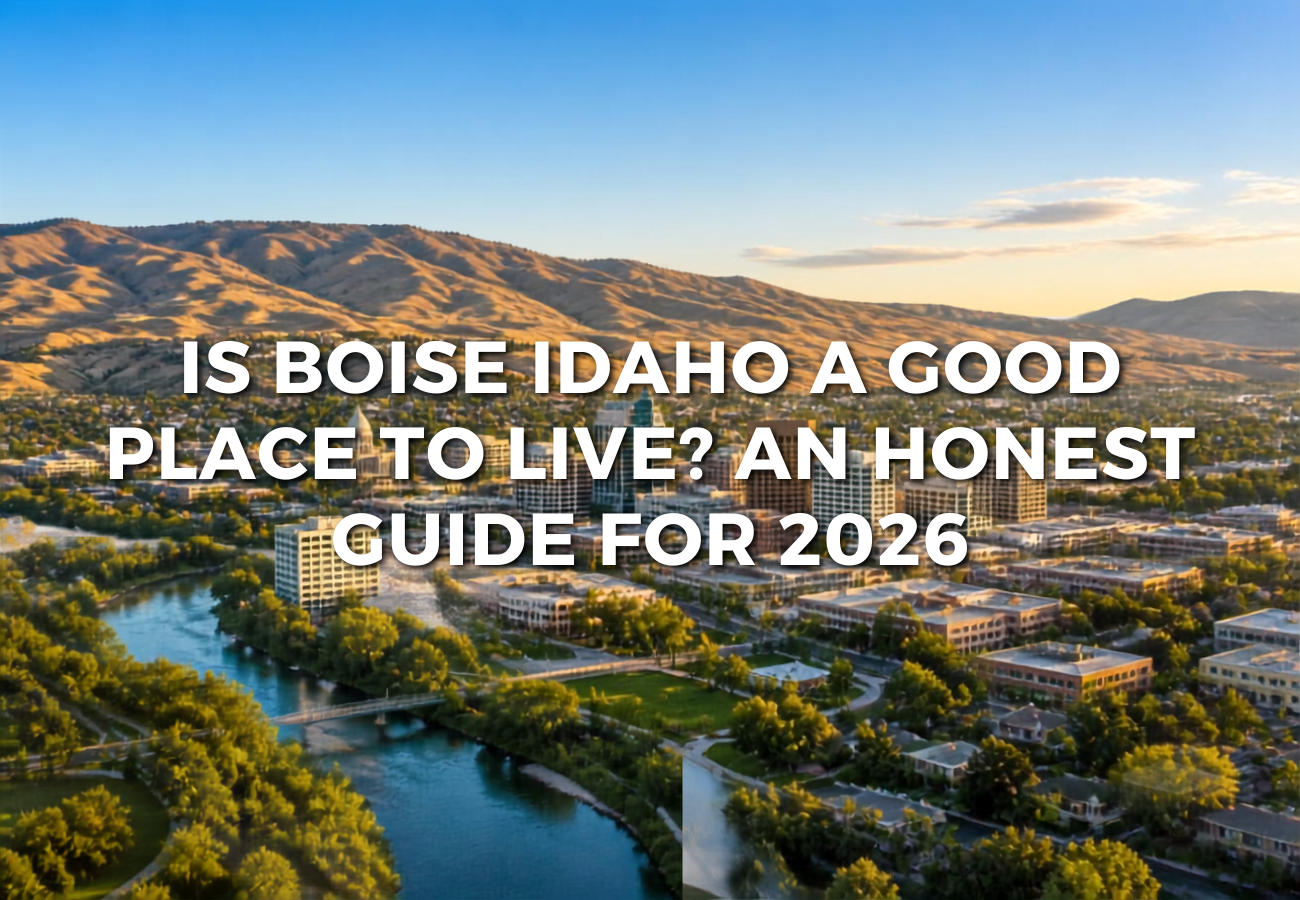
Is Boise Idaho a good place to live? The honest answer is yes — for the right person. But "the right person" matters more than most relocation content will ever tell you, and I'd rather give you a clear picture of both what Boise delivers and where it falls short than hand you a list of rankings and call it a day. I've lived in this valley for four years, helped hundreds of families make the move from California, Oregon, and Washington, and watched what happens when people arrive with accurate expectations versus when they don't.
The national data in 2026 is actually striking: Idaho was named the #1 Best State to Live In for 2026 by WalletHub, topping a ranking of all 50 states based on 51 indicators spanning affordability, economy, education, quality of life, and safety. Boise placed #2 overall among the best cities in America for a fresh start by Consumer Affairs in January 2026. Among all US state capital cities, Boise ranked second lowest for crime rates and third lowest for premature death rates in a February 2026 study. Those aren't minor footnotes. But rankings don't tell you what it actually feels like to live somewhere, and they don't tell you whether it's the right fit for your specific life. That's what this post is for.
- Cost of Living: The Real Picture in 2026
- Safety: What the Data Actually Shows
- Jobs and the Economy
- Weather: The Full Honest Version
- Outdoor Access
- Schools
- Politics and Culture
- Food, Arts, and Culture
- The Growth Story: What's Coming
- The Honest Downsides
- Is Boise Right for You?
- Frequently Asked Questions
Cost of Living: The Real Picture in 2026
Cost of living is the primary driver of most California-to-Idaho relocations, and the advantage is real — just not uniform across every category. The Treasure Valley overall runs roughly 24 to 40% less expensive than California's major metros when you factor in housing, taxes, and the structural cost differences specific to this market.
The headline numbers: Ada County median home price is approximately $540,000 to $575,000 as of mid-2026 — essentially flat year-over-year after the peak appreciation of 2021 to 2022. That's not dramatically below California metros like San Diego or the Bay Area, where comparable homes run $800,000 to $1.5 million or more. But what that $540,000 buys is dramatically different: a new construction home with 2,400 to 2,800 square feet, a three-car garage, modern systems, builder warranty, and a yard — compared to an older, smaller home in a California suburb for the same money. The square footage difference alone is often 40 to 60%.
Beyond housing, the financial picture improves meaningfully: Idaho's flat income tax rate of 5.3% (recently reduced from 5.8%) versus California's 8 to 13.3% progressive structure produces thousands of dollars in annual savings for most households. Vehicle registration: $75 per vehicle flat, versus $300 to $800+ in California. Pressurized canal irrigation keeps most Treasure Valley lawns green all summer for $135 to $190 per year. Homeowners insurance, while rising, is still a fraction of California's crisis-level market. The consistent financial relief that arrives in the first year is one of the most commonly described quality-of-life improvements. The full line-by-line comparison is in the California vs. Idaho cost of living post.
| Category | Treasure Valley, ID | California (major metros) |
|---|---|---|
| Median home price (Ada County) | ~$540,000–$575,000 | $800,000–$1.5M+ (SD, Bay Area, LA) |
| State income tax | 5.3% flat | 8–13.3% progressive |
| Vehicle registration | $75/vehicle/year flat | $300–$800+/year + smog tests |
| Property tax (effective) | 0.4–0.8% + $125K exemption | 1%+ base + special assessments |
| Lawn irrigation (summer) | ~$185/year (pressurized canal) | No equivalent — high domestic water cost |
| Grocery sales tax | 6% on groceries | No grocery tax |
Safety: What the Data Actually Shows
Idaho has the lowest total crime rate of any state in the country — 11.68 incidents per 1,000 residents. Among all US state capital cities, Boise ranked second lowest for crime rates in a February 2026 study, behind only Concord, New Hampshire. The suburban communities surrounding Boise are even lower: Meridian's violent crime rate runs approximately 1.2 per 1,000, Eagle around 0.9, Star and Kuna lower still.
The day-to-day experience shift from California to the Treasure Valley is significant in ways that data alone doesn't capture. The things that became normalized in California — car break-ins, catalytic converter theft, smash-and-grabs, the ambient anxiety of high-density urban living — are not part of daily life here. Families who move from Southern California consistently describe a physical relaxation in their first year. You can let your kids play on a cul-de-sac without a second thought. You stop checking that you didn't leave anything visible in your car. The mental overhead of low-grade safety anxiety that you didn't know you were carrying disappears — and you notice it most clearly by its absence.
Jobs and the Economy
Idaho's unemployment rate sat at 3.7% in June 2026, with Boise posting the largest metro-area job gain of any Idaho metro that month. Idaho's labor force growth consistently outpaces the national rate, driven by in-migration from a population expanding faster than almost anywhere in the country. The Treasure Valley's employment base spans healthcare, technology, construction, education, finance, and government — anchored by major employers including Micron Technology, St. Luke's Health System, Saint Alphonsus, HP Inc., and a growing cluster of technology companies.
The transformative economic story right now is Micron's semiconductor expansion — a $60+ billion commitment to two fabrication facilities in the Boise region, one of the largest private sector investments in Idaho's history. Combined with Meta's $800 million data center in Kuna, the Gemstone Technology Park ($1 billion-plus data center complex approved April 2025), and the high-wage industrial employment arriving in a valley that was primarily a mid-size government and healthcare economy a generation ago, the Treasure Valley's economic trajectory through the late 2020s is genuinely compelling. More high-wage earners competing for homes in a geographically constrained basin is one of the stronger structural appreciation arguments available anywhere in the Mountain West.
Weather: The Full Honest Version
Boise averages more than 200 sunny days per year. Summers are hot and dry — July and August regularly reach the mid-90s to low 100s°F, with low humidity that makes the heat more manageable than coastal equivalents but still requires air conditioning as non-negotiable. Winters are cold — nighttime lows in the teens and 20s°F from December through February, average annual snowfall around 19 inches — but mild compared to the Midwest or Mountain states at higher elevation. Spring and fall are genuinely beautiful with the kind of seasonal character that Southern California residents consistently describe as something they hadn't experienced before and quickly come to love.
Two weather realities that deserve specific mention because they routinely catch California transplants off guard. The winter inversion: cold air gets trapped in the Treasure Valley basin beneath warmer air above, producing flat gray sky and stagnant air for days or sometimes two to three weeks at a stretch, typically in December and January. It's not the cold that catches people — you can dress for cold. It's the particular quality of the inversion: motionless, lightless, flat. If you need sun to feel normal, this deserves serious consideration before you move. By year two, most transplants have a playbook — a trip somewhere warm in January, getting outside on every clear day between inversions. Year one without that playbook is the hardest weather challenge in this move. Wildfire smoke: the valley's basin geography concentrates smoke from regional fires in late summer. Some years it's minimal; some years the AQI reaches unhealthy levels for days or weeks in July and August. If anyone in your household has respiratory conditions, this needs to factor into your decision.
Outdoor Access
This is where Boise most consistently exceeds expectations — including for buyers who moved here specifically for outdoor access. Over 180 miles of hiking, mountain biking, and trail running routes begin at the city's northern edge with no permit, no reservation, and no trailhead parking scramble. The Boise River Greenbelt runs 25 miles through the valley. Bogus Basin ski resort is 45 minutes from downtown. Kirkham Hot Springs, the Payette River, the Sawtooth Mountains, McCall, and eventually Yellowstone are all within a day's reach.
What changes for California transplants isn't the quality of the landscape — California has extraordinary landscape. What changes is the access friction. People who went outdoors on planned weekend trips two or three times a month in California find themselves going on a Tuesday evening in Idaho. The foothills before work. The river on a random Sunday. The outdoor lifestyle shifts from events to daily rhythm, and that shift is one of the most consistently cited quality-of-life improvements in this move. More on this in the pros and cons post.
Schools
The West Ada School District — serving Meridian, Eagle, Star, and western Boise — is Idaho's largest and most consistently high-performing traditional district, with approximately 40,000 students across 49 schools. Its test scores and graduation rates consistently rank among Idaho's best, and the parental involvement culture in Idaho's suburban school communities is notably strong. For families relocating from California, the comparison is generally favorable: West Ada schools routinely outperform California's state-average public schools on comparable metrics.
Idaho also offers meaningful school choice: a $5,000 per child parental tax credit for qualifying private and homeschool programs, a homeschool framework that requires only notifying your district with no curriculum review or testing requirements, and a growing charter school sector. For families frustrated with California's public school environment or who homeschool, Idaho's framework is genuinely more supportive.
The honest complication: West Ada's rapid growth has created capacity issues at specific schools — Star Elementary is currently at 137% of design capacity, the highest in the district. School attendance boundaries change as new schools open, meaning the specific school assignment you're buying into today may shift within two to three years. The schools and traffic post covers this in full detail.
Politics and Culture
Idaho is one of the most consistently conservative states in the country, and the political culture here is not ambiguous. Constitutional carry. A flat income tax that just went down, not up. A legislature genuinely oriented toward limiting government rather than expanding it. Meaningful school choice. Strong agricultural and property rights traditions. The cultural values many people are specifically leaving California or Washington to find — these are real and they're not going anywhere. The people moving to Idaho in large numbers right now are overwhelmingly aligned with those values, not importing alternatives.
One meaningful nuance: Boise city proper is governed by Democrats — the mayor and all five city council members as of 2026. Most relocating buyers aren't moving to Boise proper — they're moving to Meridian, Eagle, Star, Nampa, or Kuna — conservative communities with conservative local leadership. If the specific political character of your local government matters to you, which city you land in within the valley matters as much as the state-level picture.
Food, Arts, and Culture
I want to be honest here because too much relocation content papers over this one. Boise's food and arts scene is good and improving every year — genuinely excellent in several categories, including local breweries, farm-to-table restaurants, the Basque cultural community (one of the largest Basque populations outside the Basque Country), and a live music scene anchored by venues like the Egyptian Theatre and Treefort Music Fest. The Idaho Shakespeare Festival at the outdoor amphitheater is a summer institution that would be notable in any American city. Eagle's restaurant corridor — Crave, Lalo, Old State Saloon, Vessel Kitchen, Gem State Brewing — is genuinely strong.
But the depth and diversity of California's food culture — authentic regional ethnic cuisine, world-class sushi, the international variety that comes from genuinely diverse immigrant communities — doesn't exist in Boise in the same way and won't for many years. The cultural gap from a major California metro to Boise is real and worth naming. Buyers who handle it best are the ones who came in acknowledging the trade rather than convincing themselves it doesn't exist. The trade-off is land, space, pace, safety, financial relief, and outdoor access — genuine and significant. The food scene gap is real too.
The Growth Story: What's Coming
The Treasure Valley reached approximately 916,000 residents across four counties as of April 2026, up more than 20% from the 2020 census. COMPASS projects the region will reach 1.1 million by 2050. That trajectory is driven by both residential in-migration and a genuine economic expansion — Micron's semiconductor facilities, Meta's data center, the Gemstone Technology Park, and the ripple effects of high-wage industrial employment arriving in a valley that was primarily a mid-size government and healthcare economy a generation ago.
For buyers, this trajectory is the fundamental long-term demand argument. More high-wage earners competing for homes in a geographically constrained basin — foothills to the north and east, desert to the south and west — is the structural condition that has driven Treasure Valley appreciation for a decade and is positioned to continue. The buyers who entered in 2015 are sitting on equity that looked impossible at the time. The 2026 window is not 2015, but the structural demand case — especially ahead of the Micron wave of employment — is still real for buyers positioned in the right communities.
The Honest Downsides
No post with "honest" in the title skips this section.
Infrastructure plays catch-up to growth. Roads, schools, and services are consistently behind the pace of residential development. This is most visible in fast-growing areas like Star, north Meridian, and northwest Eagle. It's not permanent — it's the characteristic condition of a fast-growth region — but it's real and daily in ways that don't show up on a map.
The winter inversion will test you in year one. Specifically before you have a management strategy for it. Plan for it rather than hoping it won't be as bad as described. It usually is as bad as described, and sometimes worse.
Wildfire smoke season is real and worsening. Boise's basin geography concentrates smoke in a way that some years produces weeks of unhealthy AQI. For households with respiratory concerns this deserves specific research, not a footnote.
Car dependency is total. Unlike California's major cities which have at least some transit infrastructure, the Treasure Valley is entirely car-dependent. Two cars for a two-adult household is baseline, not optional.
The job market is thinner in specialized fields. Growing rapidly in some sectors, but not California-equivalent today for technology, law, finance, entertainment, or other specialized professional fields.
Family distance. If your family is in California, you're 800 to 900 miles away. This matters in ongoing daily ways that are easier to underestimate than overestimate. Plan for it explicitly.
Is Boise Right for You?
Boise is probably right for you if: you're financially strained in California and want the same or better lifestyle for significantly less money; you have school-age children and want a safer, more family-oriented community environment; you work remotely or your skills transfer to Boise's growing economy; you want genuine outdoor access woven into your daily life; you value a conservative political and regulatory environment; or you've hit your breaking point with California's density, cost, and operational friction.
Boise may not be right for you if: your career requires California's specialized job market depth and remote work isn't viable; you're a serious food and arts person whose quality of life is significantly tied to world-class diverse dining; you genuinely cannot handle extended gray winter skies and haven't built a management strategy for the inversion; or your immediate family is in California and the distance is more than you're ready to sustain with intentional effort.
Frequently Asked Questions
Is Boise Idaho a good place to live in 2026?
For most West Coast buyers in 2026, yes. Boise offers a compelling combination of lower overall cost of living (roughly 24 to 40% below California's major metros), the lowest crime rate of any US state, over 200 sunny days per year, immediate access to 180+ miles of foothills trails, a strong and growing economy anchored by Micron's semiconductor expansion and major data center investment, and a conservative political culture many relocating buyers are specifically seeking. Idaho was named the #1 Best State to Live In for 2026 by WalletHub across 51 indicators. The honest tradeoffs are a thinner job market in specialized fields, the food and culture gap from California's major metros, the winter inversion, wildfire smoke season, and total car dependency.
What are the pros and cons of living in Boise Idaho?
The primary pros: lower cost of living than California, the nation's lowest crime rate, extraordinary outdoor access starting at the city's edge, strong and growing economy, a flat 5.3% income tax, $75 annual vehicle registration, West Ada School District quality for families, and a conservative political culture with constitutional carry, meaningful school choice, and minimal regulatory friction. The primary cons: a winter temperature inversion that produces flat gray sky for days or weeks at a stretch in December and January, wildfire smoke in late summer, infrastructure consistently playing catch-up to fast growth, total car dependency, a thinner specialized job market than California, and a genuine dining and culture gap from major metro areas.
Is Boise Idaho safe to live in?
Yes — Boise is one of the safest cities in the United States. Idaho has the lowest total crime rate of any state at 11.68 incidents per 1,000 residents. Among all US state capital cities, Boise ranked second lowest for crime rates in a February 2026 study. Meridian, Eagle, Star, and Kuna have violent crime rates among the lowest in the country, ranging from approximately 0.8 to 1.5 per 1,000 residents. Property crime does occur here, but at rates dramatically below California's major metros.
What is the job market like in Boise Idaho in 2026?
Idaho's unemployment rate was 3.7% in June 2026, with Boise posting the largest metro-area job gain of any Idaho metro that month. The transformative development is Micron Technology's $60+ billion semiconductor expansion — two fabrication facilities projected to create 17,000+ jobs over time — alongside Meta's $800 million Kuna data center and additional data center projects. For remote workers, Boise's local job market is largely irrelevant — they earn at national or California rates while benefiting from Idaho's lower costs and taxes. For specialized local employment in technology, law, or finance, the market is meaningfully smaller than California's major metros but growing significantly.
How does the cost of living in Boise compare to California?
Overall the Treasure Valley runs 24 to 40% less expensive than California's major metros. The specific advantages: Idaho's flat 5.3% income tax versus California's 8 to 13.3% progressive rate; vehicle registration of $75 versus $300 to $800+ in California; property taxes of 0.4 to 0.8% with a $125,000 exemption versus California's 1%+ base; homeowners insurance dramatically lower than California's crisis-level market; and pressurized canal irrigation for lawns costing roughly $185 per year. The one category where California is lower: no state sales tax on groceries versus Idaho's 6% grocery tax.
Is Boise Idaho good for families?
Yes — consistently ranked among the best metro areas in the country for raising a family. The West Ada School District is Idaho's top-performing large district. Idaho offers a $5,000 per child parental tax credit for qualifying private and homeschool programs. Idaho has the lowest crime rate of any US state. Outdoor access gives families genuine recreation options throughout the week. The community culture in Boise's suburban neighborhoods — particularly in communities with shared infrastructure like pools and parks — produces the kind of neighborhood life that's harder to build in California's denser metros. The caution: West Ada's rapid growth has produced overcrowding at specific schools including Star Elementary at 137% capacity, and school attendance boundaries can change as new schools open.
What do people dislike about living in Boise Idaho?
The most consistently mentioned frustrations: the winter temperature inversion that produces flat gray sky and stagnant air for days or weeks in December and January; wildfire smoke reaching unhealthy air quality levels in late summer; infrastructure — roads, schools, services — consistently playing catch-up to fast growth; total car dependency with minimal public transit; 6% grocery sales tax (a surprise for California and Oregon transplants); and a food and arts scene that is improving but falls significantly short of California's major metro depth and diversity.
Key Takeaways
- Idaho was named the #1 Best State to Live In for 2026 by WalletHub across 51 indicators. Boise ranked #2 among best cities for a fresh start and 2nd lowest among US state capitals for crime rate.
- Idaho has the lowest total crime rate of any state — 11.68 per 1,000 residents. Treasure Valley suburban communities rank among the lowest in the country for violent crime.
- The cost of living advantage over California is real and structural: 5.3% flat income tax, $75 vehicle registration, 0.4–0.8% property tax with exemption, dramatically lower homeowners insurance. Idaho's 6% grocery tax is the one consistent category where California is lower.
- Idaho's unemployment rate was 3.7% in June 2026. Micron's $60B+ semiconductor expansion and major data center construction represent transformative economic catalysts for the Treasure Valley's long-term wage and housing demand trajectory.
- Outdoor access is immediate and low-friction — 180+ miles of foothills trails start at the city's edge, no permit or reservation required. The shift from event-based to daily outdoor activity is one of the most consistently cited quality-of-life improvements.
- The honest downsides: winter inversion (flat gray for days to weeks in December–January), wildfire smoke in late summer, infrastructure playing catch-up to fast growth, total car dependency, thinner specialized job market, and a genuine food and culture gap from California's major metros.
- West Ada School District is Idaho's top-performing large district, with meaningful school choice including a $5,000/child parental tax credit. Star Elementary at 137% capacity illustrates overcrowding the district is actively addressing with new construction including Lake Hazel Elementary opening August 2027.

Curtis Chism
Licensed Idaho Real Estate Agent • eXp Realty • License #SP56593
I moved here from San Diego four years ago and have helped hundreds of families figure out whether this move is right for their specific situation. That conversation starts at weknowtreasurevalley.com/about.
Ready to Figure Out If Boise Is Right for You?
The relocation guide is where to start. Then let's have a specific conversation about your situation — budget, timeline, lifestyle priorities, and which part of the valley actually fits your life.
Get the Relocation Guide Call or Text: 208-510-0427