One of the first decisions every relocating buyer faces in the Treasure Valley isn't which house to buy — it's which kind of life to buy. Urban Boise and suburban Meridian, Eagle, or Star are the same metro area on a map, but they produce genuinely different daily experiences. The commute feels different. The weekends feel different. The neighbors feel different. And the price tags reflect that.
I moved here from San Diego four years ago, and I've watched clients make this call hundreds of times. Some come in convinced they want the walkability and neighborhood character of Boise proper — and they're right. Others assume they want the space and schools of the suburbs — and they're right too. The ones who struggle are the ones who pick based on a list of features rather than an honest read of how they actually live. This post is designed to help you do that honestly.
A few definitions before we get into it. When I say "urban" in this context, I mean the walkable neighborhoods of Boise city — the North End, Hyde Park, Downtown, and East Boise along the Greenbelt. When I say "suburban," I mean the planned communities of Meridian, Eagle, Star, Nampa, Kuna, and Middleton — the newer, family-oriented communities that have driven most of the Valley's growth over the past decade. Neither category is better. They're different, and one of them fits your life better than the other.
- The Core Tradeoff
- Urban Boise: What You Actually Get
- The North End and Hyde Park
- East Boise and the Greenbelt Corridor
- Suburban Treasure Valley: What You Actually Get
- Meridian: The Suburban Benchmark
- Eagle: Suburban With a Premium
- Star, Nampa, Kuna, and Middleton
- Price Comparison: Urban vs. Suburban
- For Families With Kids
- Commute and Car Dependency
- How to Actually Decide
- Frequently Asked Questions
The Core Tradeoff
Urban Boise gives you walkability, neighborhood character, architectural history, and proximity to the culture and amenities that make Boise feel like a real city. You pay for it in home size, lot space, and entry price per square foot. Suburban Treasure Valley gives you newer construction, more space, better schools by most measures, community infrastructure, and significantly more home for the money. You give up walkability and get a car-dependent lifestyle in return.
Neither of those is inherently a problem. Car dependency in Boise's suburbs is nothing like car dependency in Los Angeles — commutes here are 20 to 30 minutes, not 90. And the walkability of the North End, while genuinely good by mid-size city standards, isn't San Francisco. The Valley is car country, period. The question is whether you want the option to walk to coffee and dinner, or whether you'd rather have a three-car garage and a neighborhood pool. Both are valid. Knowing which one matters to you before you fall in love with a house is what prevents an expensive mistake six months later.
Urban Boise: What You Actually Get
Boise's walkable neighborhoods are concentrated in a relatively small geographic footprint — the North End, Hyde Park, Downtown, and the stretch of East Boise along the Greenbelt. Downtown Boise has a Walk Score of 80, the highest in the city. The North End runs in the mid-60s to low 70s depending on the block. Morris Hill and Depot Bench sit in the 60s. Outside of those pockets, Boise gets car-dependent fast — the city as a whole has a Walk Score of 34.
What those walkable neighborhoods actually offer: coffee shops and restaurants you can reach on foot, mature tree canopies, architectural character that new construction simply can't replicate, and the particular energy of streets that people actually use. The Idaho Shakespeare Festival performs outdoors in summer about a mile from the North End. Freak Alley Gallery, the city's signature outdoor mural installation, is downtown. The Treefort Music Festival fills downtown Boise every spring. These aren't things you drive to from Meridian once a quarter — they're part of your regular landscape if you live in Boise proper.
The Boise Foothills are the urban neighborhoods' great equalizer. The North End literally backs up against the trail system — you can walk out your front door and be on singletrack in five minutes. Camel's Back Park, Military Reserve, and Hulls Gulch are all immediately accessible. For outdoor-focused buyers who also want walkability and city feel, the North End delivers a combination that the suburbs genuinely can't match. The Boise city guide goes deeper on neighborhoods and what each area offers.
The North End and Hyde Park
The North End is the most sought-after urban neighborhood in Boise, and the price reflects it. Homes here are predominantly Craftsman bungalows, Queen Anne cottages, brick Tudors, and American foursquares — the kind of architectural inventory that hasn't been built in 80 years and can't be replicated. Hyde Park, the commercial heart of the North End, has locally owned restaurants, coffee shops, a hardware store, and the kind of streetscape that feels genuinely lived-in. It's not a curated lifestyle district — it's a real neighborhood that happens to also be desirable.
The tradeoff is lot size. North End homes sit on 6,000 to 7,500 square foot lots, sometimes smaller, with the home footprint eating most of the available space. Side yards are narrow. Garages, if they exist, are detached and accessed from alleys. If you're coming from a California suburb expecting to park an RV, run a sprinkler system across a half-acre, and leave your garage door open without neighbors noticing — the North End will frustrate you. If you're coming from a San Francisco flat or a Portland rowhouse and you prioritize walkability and neighborhood character over square footage, the North End might be the best housing product in the entire Valley for your lifestyle.
East Boise and the Greenbelt Corridor
East Boise — the neighborhoods along and near the Boise River Greenbelt from roughly Warm Springs Avenue east through Barber Valley — offers a different flavor of urban living. Less neighborhood commercial concentration than Hyde Park, but direct Greenbelt access, some of the best cycling in the city, and a mix of mid-century modern homes alongside newer Barber Valley master-planned development. Homes here skew toward the $450,000 to $750,000 range depending on age, proximity to the river, and whether you're in an established Greenbelt neighborhood or the newer Barber Valley development.
The Warm Springs and East End neighborhoods adjacent to downtown Boise attract buyers who want the walkable commute to downtown jobs without the premium of the North End. Architectural character is strong in pockets — mid-century ranches, 1960s split-levels, and some genuinely interesting contemporary infill. For buyers who care about the river and cycling access over Hyde Park-style walkability, East Boise consistently performs well and tends to hold value through market cycles.
Suburban Treasure Valley: What You Actually Get
The suburbs of the Treasure Valley — primarily Meridian, Eagle, Star, Nampa, Kuna, and Middleton — are where most of the Valley's growth has landed and where most relocating buyers end up. The reasons are straightforward: newer construction, more square footage per dollar, better schools in the West Ada School District, and community infrastructure (pools, parks, trails, shopping) that planned communities deliver more reliably than urban infill.
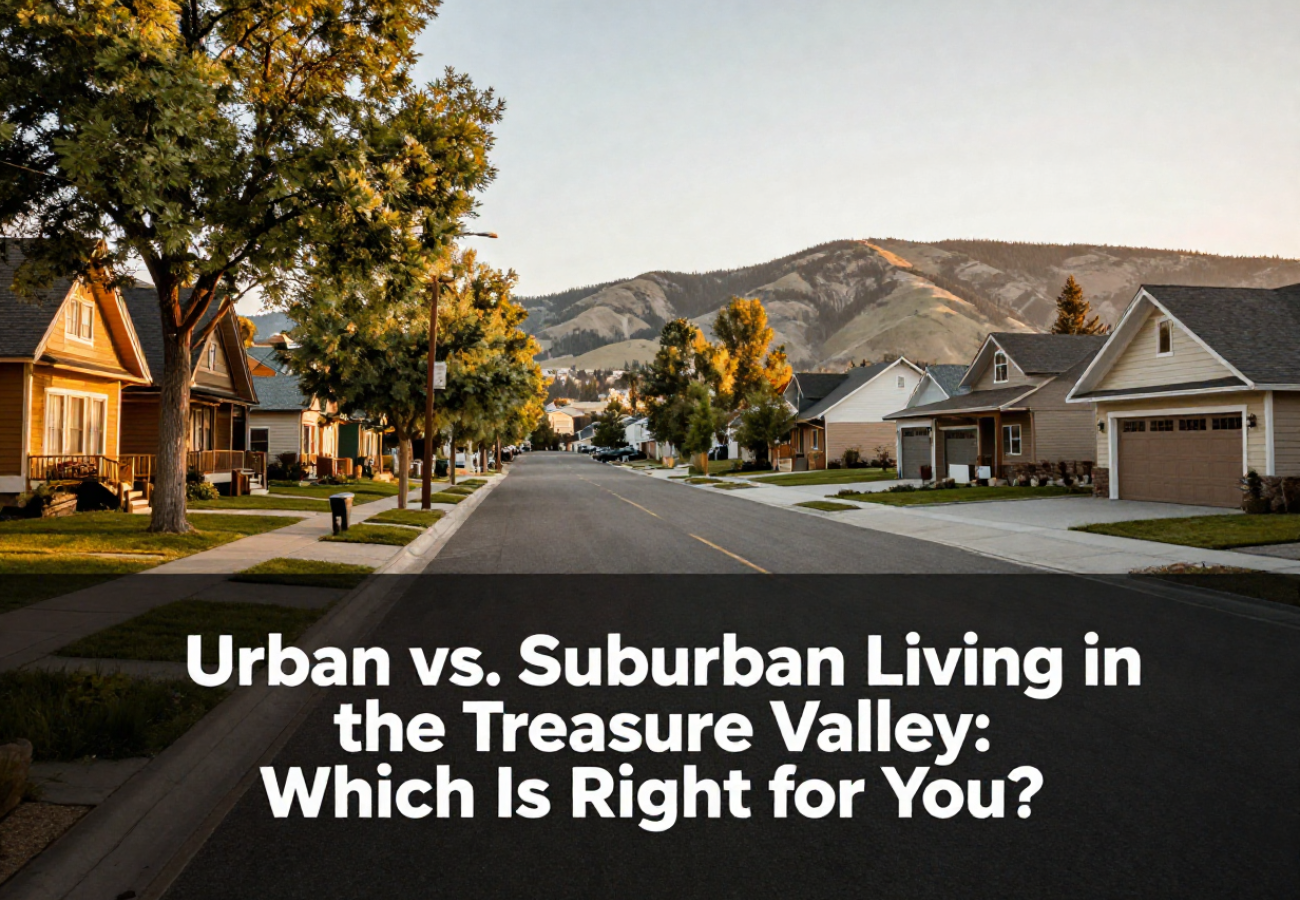
The dominant housing type is new construction or near-new single-family homes on 6,000 to 10,000 square foot lots — three-car garages, open floor plans, 2,200 to 3,000 square feet, built in the last five to fifteen years. These homes don't have the character of a 1920s Craftsman bungalow, but they have better energy efficiency, modern systems, and warranties. Most communities include HOA amenities — pools, playgrounds, trails, sometimes clubhouses — that create a built-in social infrastructure, especially for families with kids. The community pool I'm moving toward in Star is a perfect example: it's not just an amenity, it's the reason neighbors actually meet each other.
Meridian: The Suburban Benchmark
Meridian is the most popular landing spot for relocating buyers in the entire Valley, and it earns that distinction. It has the best overall package for families: top-rated West Ada School District schools, excellent new construction inventory across a wide price range, strong amenity buildout (The Village at Meridian, Settlers Park, Julius M. Kleiner Memorial Park), and commute times that run about 23 minutes on average to major employment centers. The median sale price in March 2026 was approximately $560,000, up 3.7% year over year.
West Ada School District educates more than 38,900 students across 49 schools in Meridian, Eagle, Star, and western Boise. It's the largest district in Idaho and consistently ranks at the top of the state on the Idaho Standards Achievement Test. Rocky Mountain High School, Owyhee High School, and Mountain View High School all serve Meridian students and carry strong academic and athletics reputations. For families for whom school quality is the primary location driver, Meridian is the most reliable choice in the Valley.
Eagle: Suburban With a Premium
Eagle sits between Meridian and Star geographically and occupies a distinct market position: more upscale than Meridian, less expensive than the North End, and oriented around the Boise River, greenbelt access, and a genuine small-town commercial core on State Street. The median home price in Eagle runs higher than Meridian — buyers should budget $600,000 to $1.2 million for most of the city's desirable inventory, with premium foothill and river-adjacent properties pushing past that.
Eagle's character is different from Meridian in ways that matter to buyers. Lots tend to be larger. The downtown has boutique shops, local restaurants, and the kind of streetscape that feels more established than a new subdivision retail strip. The Boise River runs along Eagle's northern edge, and several neighborhoods have direct trail and Greenbelt access. For buyers coming from areas like Bellevue, Scottsdale, or the more upscale San Diego suburbs who want suburban lifestyle without suburban anonymity, Eagle tends to land well. The Eagle city guide goes deeper on neighborhoods and price tiers.
Star, Nampa, Kuna, and Middleton
These four communities represent the outer rings of the suburban Treasure Valley and serve distinct buyer profiles. Star is the fastest-growing city in Idaho at 8.48% annual growth, sitting in Ada County with foothills adjacency and a distinctly patriotic small-town culture. It's the value play within Ada County — priced below Eagle but positioned near it, with Highway 16 completion in 2027 set to change its commute dynamics significantly. My family is moving there from Nampa, and it's the move I'd recommend for buyers who want Ada County appreciation upside without Eagle's price tag.
Nampa and Caldwell in Canyon County offer the Valley's lowest entry points — median prices around $400,000 to $435,000 — with strong cash flow for investors and a surprisingly active community calendar anchored by Indian Creek Plaza's 260 annual events. The honest tradeoff: Canyon County is 30 to 40 minutes from the foothills and Eagle's amenities, and the commute to Ada County employment centers runs longer. Kuna and Middleton are smaller, quieter, and priced accordingly — good fits for buyers who want Idaho's semi-rural feel without going fully rural, and who don't need to be close to the Valley's commercial core day-to-day. For the Canyon County vs. Ada County strategic question, the cost of living analysis breaks down the financial picture in detail.
Price Comparison: Urban vs. Suburban
Here's how the major neighborhoods and cities compare on price per square foot and overall median — the metric that actually tells you what your money buys:
| Area | Typical Median / Range | Home Character | Walk Score |
|---|---|---|---|
| North End / Hyde Park | $550K–$950K+ | Historic Craftsman/Tudor, small lots, character | 65–75 (walkable) |
| Downtown Boise | $400K–$700K (condos/townhomes) | Condos, lofts, newer urban infill | 80 (very walkable) |
| East Boise / Greenbelt | $450K–$750K | Mid-century, some new infill, river access | 40–60 (car-dependent to some services) |
| Meridian | ~$560K median (March 2026) | New construction, planned communities, 3-car garages | 25–40 (car-dependent) |
| Eagle | $600K–$1.2M+ | Larger lots, river access, upscale suburban | 25–35 (car-dependent) |
| Star | $480K–$750K | New construction, foothills adjacency, fast growth | 20–30 (car-dependent) |
| Nampa / Canyon County | ~$400K–$435K median | Mix of older and newer, most affordable entry | 25–40 |
| Kuna / Middleton | $320K–$460K | Smaller towns, semi-rural, growing | 15–25 (very car-dependent) |
The price-per-square-foot gap between urban and suburban is real. A 1,600 square foot North End Craftsman might sell for $575,000. A 2,600 square foot new construction home in Meridian might sell for $545,000. You're getting 60% more living space for slightly less money — but you're giving up neighborhood character, walkability, and the particular kind of community that comes from living on a street that people actually walk down. The question is what you value more. Neither answer is wrong. For a fuller picture of how these numbers stack up financially, see the California vs. Idaho cost comparison.
For Families With Kids
If you have school-age children, the suburban case gets significantly stronger. West Ada School District — serving Meridian, Eagle, Star, and western Boise — is Idaho's largest and best-funded district, with 38,900+ students across 49 schools. It consistently ranks first among Idaho's large traditional districts on state achievement testing. The contrast with Boise School District isn't dramatic, but it's real: Boise's district has more variability across schools, with the highest-rated elementaries concentrated in the North End and East Boise areas, while some parts of the district are more average.
Beyond academics, suburban communities are simply more built around families in a physical sense. Neighborhood pools give kids a gathering place that walkable urban blocks can't replicate. Youth sports leagues, splash pads, and wide sidewalks are abundant in Meridian and Eagle in a way that's more mixed in urban Boise. Families who move from urban California neighborhoods to suburban Treasure Valley communities consistently describe a shift in how much their kids are actually outside — visible, active, in the neighborhood. That's a real quality-of-life change that doesn't show up in any comparison table.
Commute and Car Dependency
Boise's urban neighborhoods offer the one meaningful exception to the Valley's car dependency: you can live in the North End and walk or bike to a real job in downtown Boise. The 8th Street corridor runs from Hyde Park directly into the heart of downtown in under a mile. Boise has about 19 bus lines covering the city, though transit is minimal by most urban standards. For remote workers, location barely matters — connectivity is solid across the Valley and Mountain Time is workable for most West Coast roles.
Suburban commutes average 20 to 30 minutes to most Valley employment centers from Meridian, Eagle, and Star — faster than almost any comparable suburban ring around a major U.S. city. The friction points are specific corridors: Eagle Road through Meridian, Highway 44 through Star, and I-84 westbound during the evening commute from Canyon County. Your specific origin and destination determine how much of that friction you personally absorb. One of the most important conversations I have with clients is about where they'll actually be driving to and from every day — because where you buy in the Valley has a much bigger impact on daily commute quality than which city you choose in the abstract. The development watch post covers the infrastructure projects — especially Highway 16 — that will reshape commute patterns across the northwest Valley over the next two years.
How to Actually Decide
Run through these questions honestly. Your answers will tell you more than any comparison table.
Do you walk to things today, and would you miss it? If you currently walk to coffee, dinner, or errands in your California neighborhood and that matters to you — not as a nice-to-have, but as a real daily habit — urban Boise is worth the price premium and tighter square footage. If you drive to everything today and don't think twice about it, suburban Treasure Valley will feel completely normal.
Do you have school-age kids? If yes, West Ada School District is a meaningful advantage that points toward Meridian, Eagle, or Star. The difference between districts isn't catastrophic, but it's real, and the suburban community infrastructure around families is noticeably stronger.
What does your budget actually unlock? In the North End, $600,000 buys you a 1,600 to 1,900 square foot historic home on a small lot. In Meridian, $600,000 buys you a 2,400 to 2,800 square foot new construction home with a three-car garage. If space is a priority, the suburban math is hard to argue with. If character and neighborhood feel matter more than square footage, urban Boise is where that exists.
Where will you spend your recreational time? If foothills trails are your primary outdoor activity, the North End's immediate access is a genuine lifestyle advantage — you walk out the door and you're on singletrack. If river access, boating, or weekend drives to Sun Valley define your outdoor life, the specific starting point matters less. All of the Valley gets you there in roughly the same time.
Do you have boats, RVs, or outdoor toys? Storage is harder in urban Boise. Most North End lots don't have room for a trailer, and HOAs are more restrictive. The suburbs — especially Star, Nampa, and properties with larger lots — make that lifestyle much more practical. As I've written about before in the pros and cons post, the outdoor toy storage question catches more buyers off guard than almost anything else when they move here.
Frequently Asked Questions
Is it better to live in Boise proper or the suburbs?
It depends on what you're optimizing for. Boise proper — specifically the North End, Hyde Park, and East Boise — offers walkability, architectural character, foothills trail access, and urban amenities that the suburbs don't replicate. The suburbs — Meridian, Eagle, Star — offer more square footage per dollar, newer construction, better overall school infrastructure through West Ada School District, and community amenities like neighborhood pools that urban Boise generally doesn't have. Families with children tend to land in the suburbs; buyers who prioritize walkability and neighborhood feel tend to choose Boise proper.
What is the most walkable neighborhood in Boise Idaho?
Downtown Boise is the most walkable neighborhood with a Walk Score of 80. The North End and Hyde Park area ranks third overall, with Walk Scores in the mid-60s to low 70s depending on the block — walkable to daily errands, restaurants, and the foothills trail system. Morris Hill and Depot Bench also score well. Outside of these neighborhoods, most of Boise and the surrounding suburbs are car-dependent, with Walk Scores in the 20s to 40s.
Are Boise suburbs good places to live?
Yes — Meridian, Eagle, and Star consistently rank among the best places to live in the Pacific Northwest and Mountain West by most quality-of-life metrics. Meridian specifically offers top-rated West Ada School District schools, strong new construction inventory, a median commute of about 23 minutes, and a growing retail and restaurant base. Eagle adds river access and a more upscale feel. Star is the fastest-growing city in Idaho and offers Ada County appreciation upside at lower prices than Eagle, with Highway 16 set to significantly improve access when it opens in 2027.
What is the North End of Boise like?
The North End is Boise's most desirable urban neighborhood — a historic area of Craftsman bungalows, brick Tudors, and early cottages with mature tree canopies, Hyde Park's walkable commercial strip, and immediate access to the Boise Foothills trail system. It's the most walkable residential neighborhood in the city outside of downtown, with genuine neighborhood character that newer developments can't replicate. Home prices run $550,000 to $950,000+ and inventory is tight. It's the right choice for buyers who prioritize walkability, character, and foothills access over square footage and suburban amenities.
Is Meridian Idaho a good place to live?
Meridian is the most popular landing spot for Treasure Valley relocators for good reason. It offers the strongest overall package for families: West Ada School District with Idaho's top academic performance among large districts, broad new construction inventory from the mid-$400s into the high $600s, Julius M. Kleiner Memorial Park, The Village at Meridian retail complex, and average commute times of about 23 minutes. The main friction points are Eagle Road congestion during rush hour and the car-dependent nature of most of the city's newer subdivisions. For families prioritizing schools and suburban infrastructure, it's the most reliable choice in the Valley.
How does Eagle Idaho compare to Meridian Idaho for living?
Eagle sits above Meridian on price and feel — larger lots, river and Greenbelt access in many neighborhoods, a more established downtown with boutique dining and shops, and a generally more upscale suburban character. Median prices run $600,000 to $1.2 million in most desirable areas, compared to Meridian's ~$560,000 median. Both cities are served by West Ada School District. Eagle is the better fit for buyers who want suburban lifestyle with more space and premium feel; Meridian is better for buyers who want maximum value per dollar within Ada County. Star sits between them geographically and on price, with better appreciation upside in many corridors.
What are the downsides of living in suburban Treasure Valley?
Total car dependency is the primary downside — public transit is minimal across the suburban Valley and you will drive for everything. Eagle Road and Highway 44 have real rush-hour congestion on specific corridors. Some newer subdivisions feel visually homogenous, with tight lot spacing and limited architectural variety. Retail and restaurant options, while growing fast, still require driving and are often concentrated in strip mall or lifestyle center formats rather than walkable streetscapes. If you're coming from a dense, walkable urban neighborhood, the daily rhythm feels different — and that adjustment is real, even if most buyers ultimately embrace it.
Can you walk to things in Boise Idaho?
In specific neighborhoods, yes. Downtown Boise has a Walk Score of 80 and genuine walkability to restaurants, shops, and cultural amenities. The North End and Hyde Park allow residents to walk to coffee, dining, and errands, and to access the Boise Foothills trail system on foot. Outside of those neighborhoods — including most of East Boise, the Central Bench, and all of the suburban cities — Boise and the Treasure Valley are car-dependent. Most errands require a car, and transit options are limited. If walkability is a priority, focus your search on the North End, Hyde Park, and Downtown Boise specifically.
Key Takeaways
- Urban Boise (North End, Hyde Park, East Boise) offers genuine walkability, architectural character, and foothills trail access — at the highest price per square foot in the Valley and on smaller lots.
- Suburban Treasure Valley (Meridian, Eagle, Star, Nampa) delivers more square footage per dollar, newer construction, better school infrastructure through West Ada School District, and community amenities like neighborhood pools.
- Downtown Boise has a Walk Score of 80 — the city's most walkable area. The North End runs in the mid-60s to low 70s. Most suburban communities score 20 to 40, meaning car-dependent for nearly everything.
- Meridian's median sale price was ~$560,000 in March 2026 (+3.7% YoY), making it the most popular and value-oriented suburban option. Eagle runs $600,000 to $1.2M+. Star offers Ada County upside at prices below Eagle, with Highway 16 opening in 2027 as a near-term catalyst.
- West Ada School District — serving Meridian, Eagle, Star, and western Boise — is Idaho's largest and top-performing district by state testing. It's a meaningful advantage for families and points toward the suburbs.
- Average suburban commutes run 20 to 30 minutes across most of the Valley — short by national standards, though specific corridors (Eagle Road, Highway 44) have real rush-hour friction.
- The urban vs. suburban choice comes down to how you actually live: walkability and character vs. space and school infrastructure. Neither is wrong. Getting it right means being honest about your daily habits before you fall in love with a house.
- Canyon County (Nampa, Caldwell, Middleton) offers the Valley's lowest entry prices at $400,000 to $435,000 median — a viable first landing spot for buyers building equity before moving up into Ada County.

Curtis Chism
Licensed Idaho Real Estate Agent • eXp Realty • License #SP56593
I relocated from San Diego to Idaho four years ago and have lived on both sides of this comparison — I know the Valley at street level. Whether you're drawn to the North End or to a new build in Star, let's figure out which version of this place actually fits your life. Learn more at weknowtreasurevalley.com/about.
Not Sure Whether Urban or Suburban Is Right for You?
That's exactly the conversation worth having before you start touring homes. Let's talk through how you live, what you prioritize, and which part of the Valley sets you up best for the life you're building here.
Get the Relocation Guide Call or Text: 208-510-0427